

For years, customer service ran on a quiet compromise. You could be always available, or you could be genuinely helpful. Rarely both and never without spending a fortune.
So businesses split the difference. They bolted a chatbot onto the website for the after-hours queries and the simple questions. And then kept the human team for everything that actually mattered. The bot deflected. The customer got a list of help articles they had already read. And the hard problems still waited in a queue until Monday morning.
That compromise is ending. With Agentforce, Salesforce's agentic AI platform, "always-on" no longer has to mean "barely useful." The support that is awake at 2 am can now reason, take action, and resolve the issue, not just acknowledge it. This guide looks at why traditional always-on support falls short, how Agentforce actually works, what intelligent support looks like in practice, the benefits for enterprises, and what it takes to get it right.
Why 24/7 Support Has Been Broken for Years?
The promise of round-the-clock service is not new. Most enterprises have offered it for years through chatbots, IVR phone menus, and self-service help centres. The problem is that "available" and "helpful" have never been the same thing.
Traditional chatbots follow scripts. They map a customer's question to a predefined path, and as long as the customer stays on that path, things work. The moment the question is phrased differently, spans two topics, or needs information from another system, the bot loses the thread. It loops, repeats itself, or does the only thing it knows how to do - hand the customer to a human. Outside business hours, there is no human to hand them to.
IVR phone menus have the same flaw in a different form. "Press 1 for billing, press 2 for accounts" is a decision tree, not a conversation. It routes the customer; it does not resolve anything.
The result is a familiar pattern. Routine questions get deflected with links the customer has already seen. Anything genuinely difficult gets parked until an agent is online. Customers learn that the after-hours channel is a holding pen, not a help desk. And the support team starts each morning with a backlog of everything the bot could not handle overnight.
This is the gap Agentforce is built to close.
Meet Agentforce: AI That Resolves, Not Just Responds
Agentforce is Salesforce's platform for building and deploying autonomous AI agents - software that can understand a request, decide what to do about it, and carry it out inside your business systems. In a customer service context, an Agentforce service agent does the work a scripted bot never could: it holds a real conversation, resolves the issue, and only involves a human when the situation genuinely calls for one.
What makes that possible is a handful of capabilities working together:
1. From scripted bots to reasoning agents
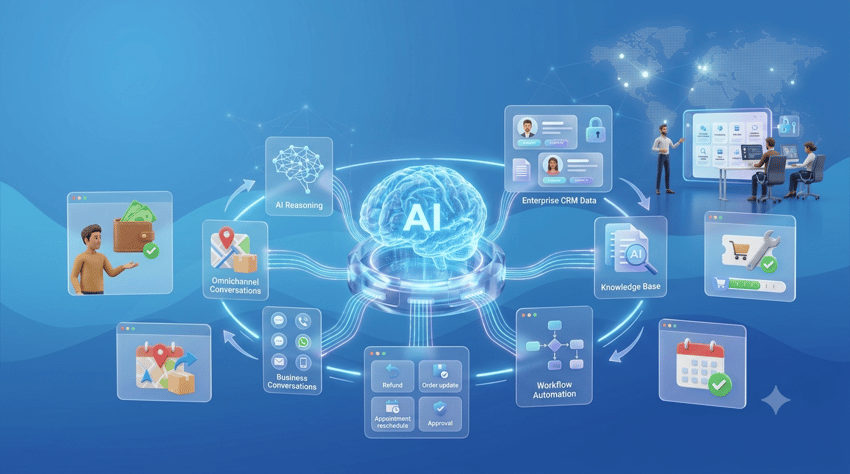
At the core of Agentforce is the Atlas Reasoning Engine. Instead of matching keywords to a script, it interprets what the customer actually wants, breaks the request into the steps needed to resolve it, and works through them in order. If a customer says, "I was charged twice, and I want the second one refunded to my original card," the agent grasps the intent, checks the transaction history, applies your refund policy, and processes the refund. It reasons towards an outcome rather than reading from a tree. That single shift, from pattern-matching to reasoning, is what separates an intelligent agent from the chatbot that came before it.
2. Grounded in your business data
An agent is only as trustworthy as the information it works from. Agentforce is grounded in your business through Salesforce Data Cloud, your CRM records, and your knowledge base, so its answers reflect your products, your policies, and that specific customer's history. This grounding is what keeps responses accurate and sharply reduces the hallucination risk that makes generic AI tools unsafe for customer-facing work. The agent answers from your trusted data, within guardrails you define, rather than from guesswork.
3. Built to act, not just answer
The real shift is from a bot that answers to an agent that acts. Through Salesforce Flows, APIs, and integrations, an Agentforce agent can take the actions a customer is actually asking for: update a delivery address, process a return, issue a refund, reschedule an appointment, or check an order status, and confirm the result on the spot. The conversation ends with the problem solved, not with a ticket logged for someone to pick up later.
4. One intelligent layer across every channel
Customers do not think in channels. They start on web chat, follow up over WhatsApp, and call when it is urgent. Agentforce works across all of them: web and in-app chat, WhatsApp, SMS, and voice, with the same reasoning and the same data behind each. A conversation that begins in one channel carries its context to the next, so the customer never has to start over or repeat themselves.
5. Designed to know when to bring in a human
Intelligent support is not about removing people. When a case is genuinely complex, sensitive, or high-value, the agent escalates it to a human and hands over the full context, not a blank slate. Your agent picks up a briefed conversation inside the same Service Cloud console, with the history, the customer's intent, and everything the AI has already tried. The handoff is seamless, and the customer feels the difference.
Always On. Actually Useful. Here's What That Looks Like
The difference becomes obvious the moment you move from theory to the support queue. Here are some practical scenarios where Agentforce changes the day-to-day customer support:
Scenario 1
A customer wants to change a delivery address, check an order status, process a return, or restore access to their account. The agent understands the request, retrieves the record, takes the action in the system, and confirms it: start to finish, without a human touching it. These are the high-volume, repetitive cases that consume most of a service team's day, and the agent simply handles them.
Scenario 2
Support stops having office hours. A query at midnight gets the same informed, accurate response as one at midday, in the customer's own language, across time zones. For a global enterprise, that is the difference between "we will get back to you when the office opens" and "it is already sorted."
Scenario 3
A customer starts a return on web chat, gets interrupted, and picks it up later on WhatsApp. The agent already knows where they left off. No repeating the order number, no re-explaining the problem. The context follows the customer.
Scenario 4
A case needs a human intervention: a billing dispute, a frustrated high-value customer, a genuinely unusual problem. The agent routes it to the right human with the full conversation attached. The customer is handed to an expert, not back to the start of the queue.
Scenario 5
An agent needs help regarding a customer interaction. Agentforce can summarise long case histories, surface the right knowledge article, and draft replies grounded in your data, so even the cases that need a person get resolved faster.
Why Enterprises Are Rethinking Customer Support with Agentforce?
For an enterprise, the value of intelligent support is not just a smoother customer experience. It changes the economics and the operating model of the service itself.
1. Round-the-clock coverage without round-the-clock cost
Agentforce handles unlimited concurrent conversations, so you can serve customers 24/7 without scaling headcount in proportion to volume. The cost of being always-on stops being linear.
2. Faster resolutions and higher first-contact resolution
Because the agent resolves issues end-to-end rather than deflecting or routing, customers get answers in the moment. That lifts CSAT and cuts the volume that ever reaches a human.
3. A lower cost to serve
Automating the routine, repetitive majority of cases reduces handle times and the cost per interaction, while freeing expensive human capacity for the cases that genuinely need it.
4. Consistent, compliant, on-brand service
Every customer gets the same accurate, policy-aligned answer, every time - no variation by agent, mood, or shift. In regulated industries, that consistency becomes a compliance advantage.
5. Elastic scale for demand spikes
Seasonal peaks, product launches, and incidents no longer mean frantic hiring or long queues. Capacity flexes with demand automatically.
6. A more valuable, less burnt-out team
With the repetitive volume handled, your service agents stop being a human FAQ and spend their time on the complex, high-empathy conversations that retain customers - work that is more rewarding and far harder to automate.
7. Insight from every conversation
Each interaction is captured and structured, turning your service channel into a live source of insight on what customers need, where products fall short, and where to improve.
The One Mistake That Can Derail Your Agentforce Rollout
Here is where we would urge a little caution, because this is where we see implementations go wrong.
Agentforce amplifies whatever environment you place it in. Give it clean data, well-defined processes, and a healthy knowledge base, and it performs brilliantly. Give it fragmented records, undocumented workarounds, and a knowledge base nobody has updated since 2022, and it will confidently automate your mess at scale.
The platform is rarely the reason these projects underdeliver. The foundation is. An AI agent grounded in poor data gives poor answers faster. An agent asked to follow a process that lives only in someone's head has nothing to follow.
So the real question is not "should we adopt Agentforce?" It is "is our data and process foundation ready for it?" The businesses that win with intelligent support are the ones that get that order right. It is the same principle behind every successful AI project: the model is only as good as what sits underneath it.
How Brysa Helps You Build Always-On, Intelligent Support?
Let us reiterate - Most service teams that struggle with Agentforce do not struggle because the technology falls short. They struggle because the foundation underneath it is not ready, and that is where Brysa comes in.
As a trusted Salesforce consulting partner, we help you get the order right: foundation first, automation second. Our Salesforce Service Cloud and Agentforce Quick Start packages combine the groundwork that makes intelligent support actually deliver, consolidating your customer data into a single, trusted view, mapping the service processes worth automating, structuring your knowledge base so agents can ground their answers in it, and setting clear guardrails for what an agent handles alone and when it brings in a human.
But we do not just switch the agents on. We design, deploy, and tune them around how your service operation really runs, then keep refining as the data comes in. The goal is not a clever demo. It is measurable outcomes: faster resolutions, a lower cost to serve, and a service team freed to do the work that keeps customers loyal.
So, ready to see what always-on, intelligent support could look like for your business? Contact us now.