

“The biggest lie in CRM wasn't that the technology failed. It's that we accepted manual data entry as an unavoidable part of selling.”
CRM was always sold as a technology that would help your sales teams spend more time selling. But somewhere along the way, that promise got lost in a sea of fields, forms, and follow-up tasks. For instance, CRMs like Salesforce were designed to give you a clearer view of your customers. But take one peek at your sales team’s operations, and it will reveal that they still spend a surprising portion of their day updating opportunities, logging activities, creating tasks, and generating reports.
The irony is that the very people hired to build relationships and close deals in Salesforce are becoming your part-time data entry specialists.
But, the CRM Pyramid Is Flipping Upside Down
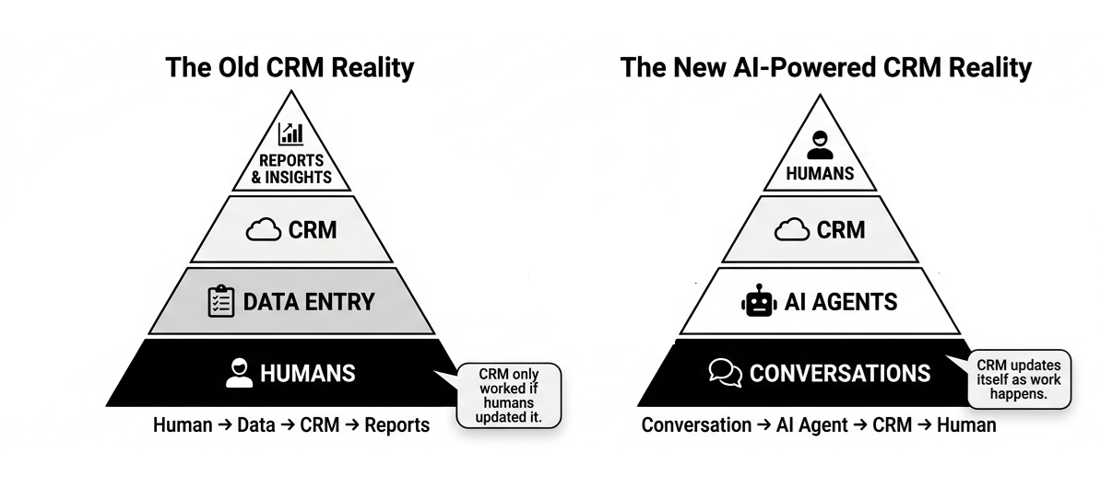
Manual CRM systems followed a simple formula: humans entered data and software generated insights. Every forecast and pipeline report depended on someone remembering to update a record. The entire CRM ecosystem was built on a one-way flow of information:
Human → Data → CRM → Reports
If the data wasn't entered, the system became blind. This is why so many sales leaders have spent years chasing CRM adoption instead of focusing on revenue growth.
AI agents are turning that model on its head. The new flow looks very different:
Conversation → AI Agent → CRM → Human
Instead of waiting for a salesperson to document what happened, AI can capture meeting discussions, extract key decisions, update opportunities, identify risks, create follow-up tasks, and surface recommendations automatically. The CRM is no longer a destination where work gets recorded after the fact. It becomes a living system that is continuously updated as work happens.
For the first time, the burden of maintaining CRM data is shifting away from humans and toward intelligent AI agents. It is changing how information moves through an organisation.
What are AI Agents? When Your CRM Starts Talking Back
In a passive CRM system, you ask questions, and it gives you answers. How much pipeline do we have? Which deals are at risk? What is the forecast for the quarter?
It acts like a digital filing cabinet, storing information and waiting for someone to analyse it. AI agents fundamentally change that relationship. Instead of simply responding to requests, they can:
- Understand context
- Make decisions within defined boundaries
- Take action on your behalf.
In simple terms, AI agents are intelligent software entities that don't just process information. They work with it. A CRM powered by AI agents won't just tell you what happened. It will tell you what to do next and often do it for you. Imagine a CRM that can:
- Notice a high-value opportunity has gone silent for two weeks
- Create a follow-up task
- Draft an outreach email
- Alert the account executive
- Updates the deal risk score automatically.
Or a customer success agent that identifies churn signals and launches a retention workflow before anyone raises a concern. Put simply, the CRM transforms from a system of record into a system of action. The CRM doesn't hear you. It talks back. It actively participates in revenue operations, continuously monitoring outcomes, learning patterns, recommending actions, and helping teams move faster than ever before.
Meet Your New Salesforce Team Member (It Doesn't Need a Laptop)
Salesforce's vision for Agentic AI goes far beyond chatbots and copilots. With Agentforce, the company has offered a special category of Salesforce user: autonomous AI agents that can understand requests, reason through tasks, access business data, and take action across workflows. Agentforce lets you create agents that can operate with a degree of autonomy, handling complex processes that would normally require human intervention. These agents work directly within the Salesforce ecosystem, leveraging CRM data, business logic, workflows, and integrations to execute tasks in real time.
Key types of AI agents you can deploy in Agentforce
- Customer Service Agent: Handles customer inquiries, resolves support cases, answers FAQs, provides troubleshooting guidance, escalates complex issues, and delivers 24/7 support.
- Sales Development Representative (SDR) Agent: Qualifies leads, engages prospects, sends follow-up emails, books meetings, nurtures pipeline opportunities, and helps sales teams focus on high-value conversations.
- Sales Coach Agent: Acts as a virtual sales trainer by conducting role-play sessions, evaluating sales conversations, providing feedback, and recommending ways to improve deal outcomes.
- Product Recommendation Agent: Guides customers to the right products based on preferences, purchase history, and business rules. It can compare products, suggest upsells, and personalise shopping experiences.
- Order Management Agent: Tracks orders, manages delivery updates, handles returns and exchanges, processes order modifications, and answers shipping-related questions.
- Employee Support Agent: Assists employees with HR, IT, onboarding, policy questions, internal knowledge retrieval, and routine workplace requests.
- Knowledge & Research Agent: Searches enterprise knowledge bases, retrieves documents, summarises information, answers internal questions, and helps employees find information quickly.
- Marketing Campaign Agent: Creates campaign briefs, generates marketing content, builds email campaigns, develops landing pages, and helps marketers launch campaigns faster.
- Lead Management Agent: Captures, scores, routes, nurtures, and escalates leads automatically while ensuring timely follow-up across the sales funnel.
- Commerce Concierge Agent: Acts as a digital shopping assistant by answering product questions, recommending products, checking availability, and supporting buyers throughout their purchasing journey.
- Billing & Financial Support Agent: Handles payment inquiries, invoice questions, subscription issues, billing disputes, and transaction-related support requests.
- Case Resolution Agent: Analyses incoming support requests, categorises cases, suggests resolutions, automates repetitive actions, and helps reduce service workloads.
- Predictive Support Agent: Monitors customer activity and operational data to identify potential issues before customers report them, enabling proactive service.
The Hidden Risk: Automating Bad Processes Faster
AI agents like Agentforce can transform how work gets done, but they are not a magic fix for broken operations. One of the biggest mistakes organisations make is assuming that deploying AI will automatically improve efficiency. In reality, AI agents amplify whatever environment they are placed in. If your Salesforce instance is filled with duplicate records, inconsistent processes, outdated workflows, and poor data quality, AI agents will simply execute those flawed processes faster and at a larger scale. A lead qualification agent is only as effective as the qualification criteria it is given. A forecasting agent can only produce reliable predictions if the underlying pipeline data is trustworthy.
This is why successful Agentforce implementations start with process discipline, not technology. Before you hand over responsibilities to autonomous agents, you need clear governance, clean CRM data, and well-defined business rules. The goal should not be to automate everything on day one. Instead, you should identify high-value workflows and gradually expand agent autonomy as trust grows. The companies that succeed with AI agents won't be those that deploy the most agents. They'll be the ones that create the right foundation for those agents to operate intelligently and in alignment with business objectives.
Brysa: Preparing You for an Autonomous Salesforce Future
The future of Salesforce isn't about adding more dashboards or workflows. It's about building a digital workforce that can operate alongside your human workforce. We are Brysa, a Salesforce consulting partner who can help you prepare for this shift by designing AI-ready Salesforce ecosystems powered by technologies like Agentforce. We believe that the most successful Salesforce organisations won't be those with the most software licenses or the most dashboards. They'll be the ones who have removed humans from the repetitive processes humans never wanted to do in the first place. And we help you achieve that. Are you ready for an autonomous Salesforce future? Contact us now