

For decades, sales technology promised one thing - productivity. Yet most systems remained passive. They recorded activity instead of driving outcomes. The reps chased follow-ups instead of closing deals. Revenue execution still depended on human bandwidth instead of using intelligent orchestration. That model soon started to break.
But with the rise of autonomous AI, sales started moving beyond tools that ‘merely assisted’ toward systems that could ‘act and decide' in real time. Salesforce Agentforce has played a key role in this transition. It offers autonomous agents that do not just support your team but actively participate in revenue workflows.
In this article, we will understand how to reinvent your sales execution and switch from assisted selling to building autonomous revenue systems using Agentforce.
What Is Salesforce Agentforce?
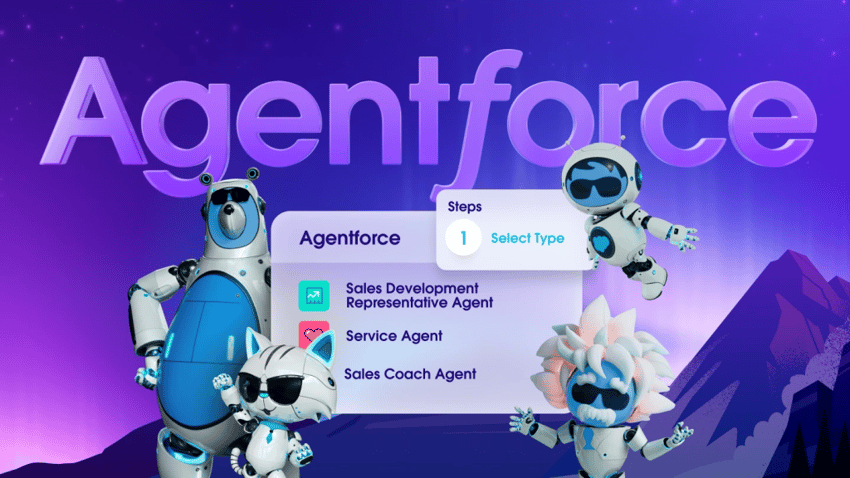
Salesforce Agentforce is an AI-powered system within Salesforce built around autonomous agents that can execute parts of the sales process, not just support it. Unlike traditional CRM platforms, which primarily store data and surface insights.
Agentforce for sales teams can act on data and trigger workflows. More importantly, it can make context-aware decisions and help manage tasks across the revenue lifecycle. This moves Salesforce from beyond being a system of record toward a system that contributes directly to execution through intelligent sales workflow automation.
Key Use Cases of Agentforce in Sales
The value of Salesforce Agentforce for sales becomes clearer when viewed through practical execution use cases. Its impact is not limited to isolated automations. Here are some practical use cases of Agentforce in sales:
1. Lead Management
Salesforce Agentforce helps automate your lead qualification and routing by using autonomous agents to assess intent signals and prioritise high-value prospects. It then directs leads to the right reps or teams. This reduces manual effort and helps your sales teams focus on opportunities with the highest likelihood to convert.
2. Opportunity Management
Agentforce supports opportunity management by tracking deal progression in real time.. It recommends next-best actions and identifies risks such as stalled deals or potential slippage early. This makes pipeline management more proactive and less dependent on manual inspection.
3. Quote-to-Cash Automation
In quote-to-cash processes, Agentforce helps streamline pricing and contract workflows through intelligent automation. By reducing bottlenecks and manual handoffs, it accelerates deal cycles and minimises delays in moving opportunities to closed revenue.
4. Sales Forecasting
Agentforce improves forecasting by using AI to analyse pipeline signals and revenue trends to predict outcomes more accurately. This gives sales leaders stronger visibility and reduces reliance on static forecast models.
5. Customer Engagement
Agentforce can recommend personalised outreach strategies based on customer behaviour and account context. This helps sales teams engage more effectively across touchpoints while improving overall customer experience.
How Agentforces Helps You Move From Assisted Selling to Autonomous Revenue Generation?
Historically, CRM systems helped businesses organise data while automation tools helped reduce repetitive tasks. Similarly, analytics platforms helped surface insights. But execution still depended heavily on people:
- Reps updated pipelines manually
- Managers interpreted dashboards
- Teams reacted to issues after they emerged.
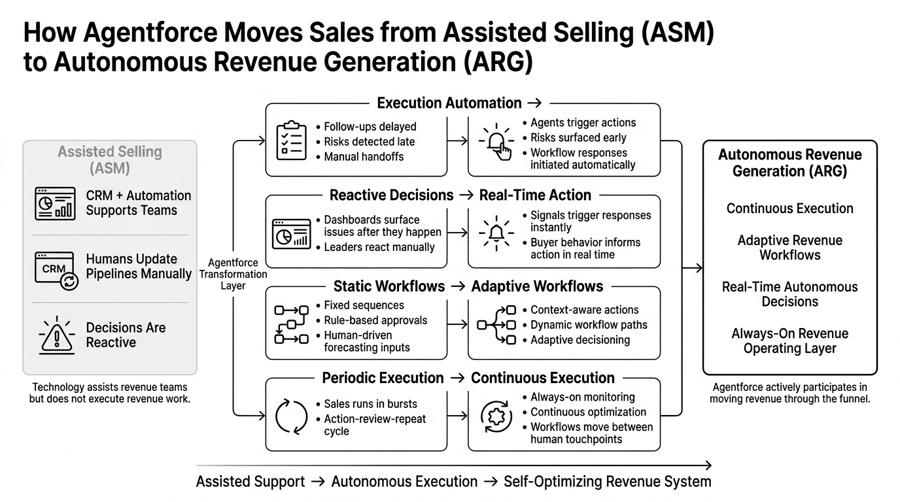
This is the Assisted Selling Model (ASM), where technology supports revenue teams but rarely participates in revenue execution itself.
Salesforce Agentforce changes that model by introducing autonomous agents that can actively contribute to how revenue moves through the funnel. This is the Autonomous Revenue Generation Model (ARG). Here’s how the transition from ASM to ARG is achieved by Agentforce:
Automating execution (not just productivity)
ASM: Sales execution often breaks down in the gaps between intent and action. A rep may know a follow-up is due, but it gets delayed. Pipeline updates may happen only before forecast calls. Opportunities may stall because no one catches risk signals early enough.
ARG with Agentforce: Many of the above execution points are managed through autonomous agents in Agentforce. Agentic AI can trigger follow-up actions, surface deal risks, recommend next steps, or initiate workflow responses without waiting for manual intervention. This changes automation from task assistance to workflow execution.
Replacing reactive decisions with real-time action
ASM: Sales decisions are largely reactive. Leaders review dashboards, spot patterns, and then decide what action to take. The problem is that by the time a dashboard highlights an issue, the issue often already exists.
ARG with Agentforce: You get a more dynamic model where real-time signals can influence action as events happen. Changes in buyer behaviour, opportunity movement, engagement drops, or service issues can trigger immediate responses. Instead of insights sitting in dashboards waiting to be acted upon, they can directly inform ongoing execution.
Making workflows adaptive rather than static
ASM: Sales processes are often rule-based and rigid. Sequences run in fixed order. Approvals follow predetermined paths. Forecasting models depend on periodic human inputs.
ARG with Agentforce: Autonomous agents make the above workflows more adaptive. Actions can adjust based on deal context, customer signals, or changing priorities. Rather than treating every opportunity through the same static process, workflows can evolve dynamically as conditions change. This is especially important in complex revenue environments where opportunities rarely move in straight lines.
Creating continuous sales execution
ASM: Sales execution often happens in bursts. Reps act, managers inspect, forecasts get updated, then the cycle repeats.
ARG with Agentforce: Execution is continuous. Agents monitor signals, act on triggers, optimise processes, and keep workflows moving even between human touchpoints. Sales becomes less dependent on manual checkpoints and more driven by an always-on operating layer.
Here is the summary of the differences between the two models:
|
Traditional Assisted Selling |
Agentforce-Powered Autonomous Revenue |
|
Manual follow-ups driven by reps |
AI agents trigger and execute follow-up actions |
|
Pipeline updates rely on seller inputs |
Opportunity signals update workflows dynamically |
|
Static dashboards surface lagging insights |
Real-time intelligence drives live decisions |
|
Reactive responses to risks and changes |
Proactive actions triggered by signals |
|
Rule-based workflows follow fixed paths |
Adaptive workflows adjust based on context |
|
Sales execution happens in periodic cycles |
Execution becomes continuous and always-on |
|
Technology supports sellers |
Technology actively participates in revenue execution |
Business Impact of Autonomous Sales Systems
By combining AI-driven execution, real-time decisioning, and adaptive workflows, systems like Salesforce Agentforce can drive measurable business outcomes across revenue performance and operational resilience. Here are some positive impacts of the autonomous sales system powered by Agentforce:
- Faster deal cycles: Automated follow-ups and proactive deal management help reduce friction across the sales process and accelerate time to close.
- Higher conversion rates: Better lead prioritisation and more personalised engagement can improve win rates and opportunity progression.
- Improved forecasting accuracy: AI-driven predictions based on live pipeline signals provide more reliable revenue forecasts and strengthen planning decisions.
- Reduced operational costs: By automating repetitive tasks and minimising manual intervention, autonomous systems can lower administrative overhead and improve sales productivity.
- Scalable revenue growth: Perhaps the biggest impact is scalability. It helps your revenue teams handle greater complexity and growth without proportionally increasing headcount or process burden.
When Your Business Needs Agentforce: A Handy Checklist
Your business may be ready for Salesforce Agentforce if several of these sound familiar:
- Your reps spend too much time on manual follow-ups and administrative work
- Lead routing and qualification are inconsistent or slow
- CRM data is incomplete or poorly adopted by your sales teams
- Forecasts often miss the mark or rely heavily on rep judgment
- Managers lack real-time visibility into pipeline health and deal risks
- Deals frequently stall because risks are identified too late
- Quote approvals and contract processes slow down revenue cycles
- Sales processes struggle to adapt as complexity or volume increases
- Scaling revenue feels tied to adding more headcount rather than smarter execution
- You want sales systems that do more than assist, and can actively help execute revenue workflows
Future of Sales Execution and How Brysa Can Help?
The future of sales execution is moving beyond AI sales automation toward complete sales autonomy. In the next few years, AI will become more embedded in your revenue operations, and sales systems will increasingly shift from supporting human execution to actively driving it. In other words, we will move toward fully autonomous revenue workflows where intelligent agents can predict outcomes and reduce dependency on manual execution across the funnel.
The long-term direction is clear: sales teams will rely less on reactive human coordination and more on predictive systems that continuously drive revenue performance.
This is where Salesforce implementations need more than technology deployment; they need the right execution strategy. At Brysa, we help you design AI-driven sales and RevOps models, implement Salesforce and Agentforce solutions, and optimise workflows through intelligent automation aligned to business goals. Our focus is not just on introducing AI to your workflows, but on driving measurable revenue outcomes from it. If your sales execution is slowing down due to manual processes, it may be time to move toward an autonomous revenue system. Contact us now to know more about us.