

Many business owners hold the mistaken belief that AI success is driven solely by better models. And that probably explains why they keep investing heavily in the latest AI platforms. According to a 2025 Deloitte survey, 85% organisations increased their AI investment in the past 12 months. And 91% plan to increase it again this year. Many of them invested, expecting quick wins, only to find their initiatives stalling in no time.The reality is far less glamorous and far more foundational. AI seldom breaks because the models are weak. It breaks because the data underneath is unreliable. When data sits in silos or contradicts itself, even the most advanced AI systems struggle to generate trust or value. In this guide, we explore how to build data foundations for AI transformations that determines whether your tech investments deliver real value or fall short.
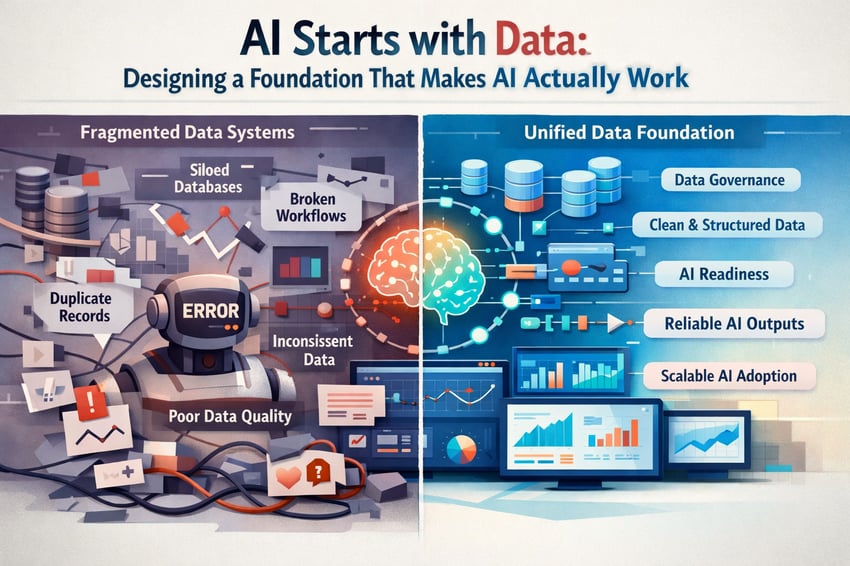
What Is a Data Foundation for AI?
In simple terms, data foundation is the combination of three core elements:
- Infrastructure
- Processes
- Governance
Together, they ensure that the data is usable and ready for AI systems. It typically encompasses how data is collected, stored, cleaned, secured, and made accessible across the organisation. When done right, a strong AI data foundation gives your systems access to high-quality and relevant data consistently. This is essential for generating accurate insights and driving meaningful outcomes.
What Data Is Needed for AI?
AI systems rely on a diverse mix of data types to learn patterns and drive decisions effectively. It is not just about having more data. It is about the right combination of structured, unstructured, historical, and real-time data that is clean and contextualised. The richer and more reliable the data ecosystem, the more accurate and valuable the AI outcomes.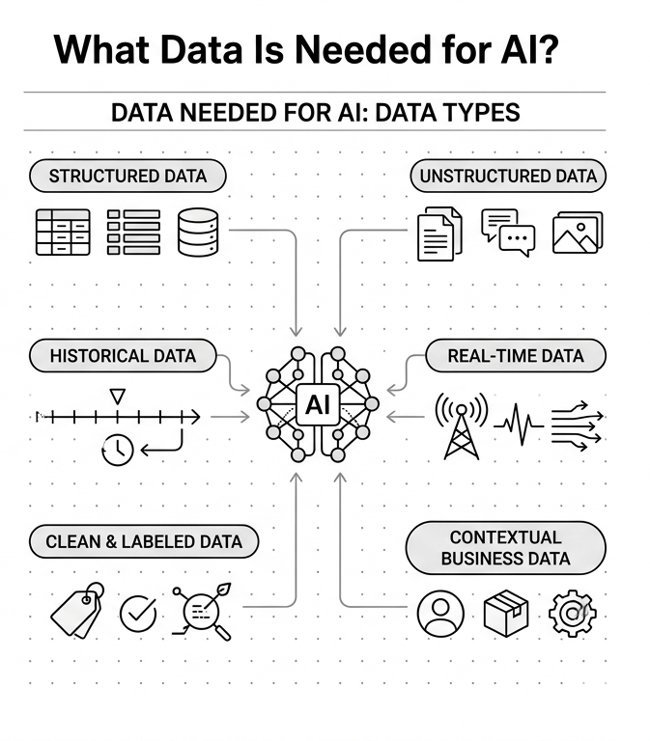 AI systems typically require:
- Structured data from systems like CRM and transactional databases that provide organised and easily analysable information
- Unstructured data, such as emails, documents, chat logs, and images, that add depth and real-world context
- Historical data to train models and identify patterns over time
- Real-time data to enable timely predictions, automation, and dynamic decision-making
- Clean and labelled datasets to improve model accuracy and reduce errors
- Contextual business data, including customer, product, and operational information, to ensure outputs are relevant and actionable
Why Most AI Projects Fail Without Data Foundations?
As we mentioned earlier, AI projects fail not because the technology backing them is inadequate, but because the data they rely on is unreliable or poorly managed. Without a strong data foundation, you will struggle to create a single source of truth. This will make it difficult for your AI systems to generate actionable insights. The result is stalled initiatives and limited business impact.
In essence, AI initiatives often fail due to:
- Siloed data across multiple systems: It prevents a unified view of the business and limits meaningful insights.
- Poor data quality: Duplicates and missing values reduce accuracy and trust.
- Lack of governance: No clear ownership or accountability for data management.
- Inconsistent data formats: Makes integration complex and slows down scaling efforts.
- Limited accessibility: Your teams cannot easily access or use data, restricting AI adoption and value creation.
How to Prepare Your Data for AI?
First and foremost, data preparation for AI is not a one-time task. It is an ongoing process. There are several steps you can follow to prepare your data and transform raw values into a reliable asset that AI can learn from and act upon. Here are the different steps: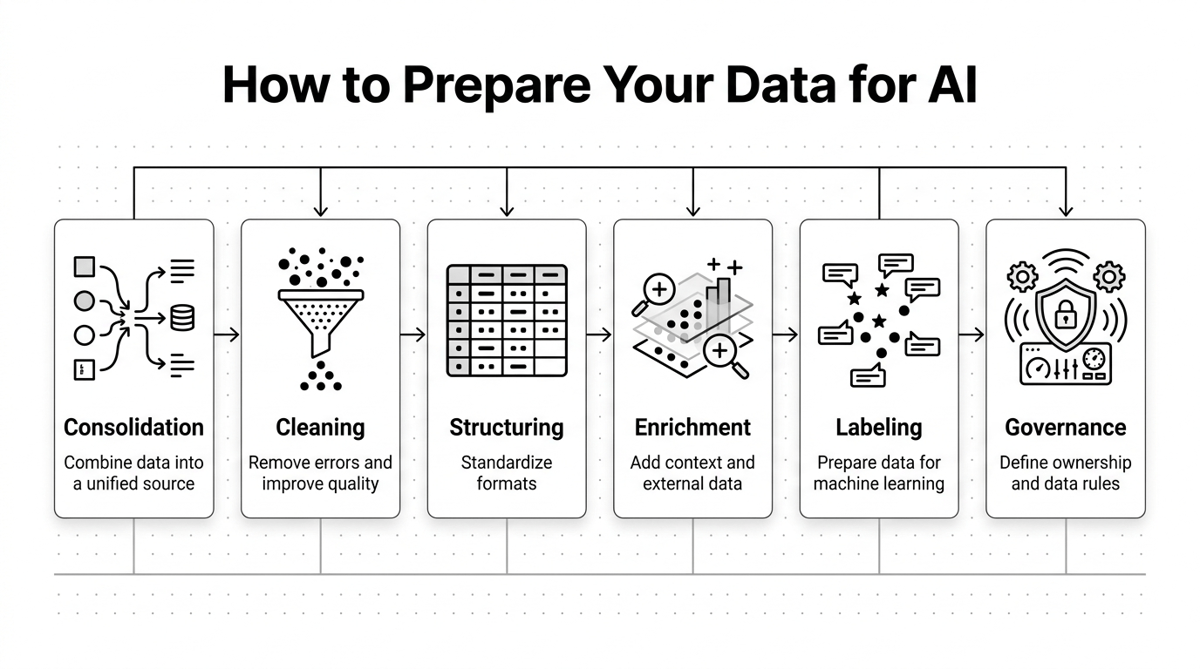
Step 1: Consolidation
This involves bringing together data from multiple sources, such as CRM systems, ERP platforms, marketing tools, and external databases, into a unified environment like a data warehouse or data lake. The goal of this step is to eliminate fragmentation and create a single source of truth. It helps your AI systems by giving access to a comprehensive and consistent dataset instead of working with isolated pieces of information.
Step 2: Cleaning
Data cleaning focuses on improving the quality of your data by removing duplicates, correcting errors, handling missing values, and resolving inconsistencies. Poor-quality data leads to unreliable AI outputs. So this step is essential to building trust in your models. Clean data also ensures that your AI systems learn from accurate information and produce dependable results.
Step 3: Structuring
Data structuring is about organising data into standardised formats and schemas so it can be easily processed and analysed. This includes defining consistent data models and relationships across datasets. Structured data makes it easier to integrate different sources. It supports your AI systems to interpret and use the data efficiently.
Step 4: Enrichment
Data enrichment enhances your existing data by adding missing information or integrating external data sources. This could include market insights or third-party datasets that provide additional context. Enriched data helps your AI systems by offering a deeper and more complete understanding of your business environment.
Step 5: Labelling
Data labelling involves tagging or annotating data so machine learning models can understand and learn from it. For example, labelling images or identifying patterns in datasets. High-quality labelled data is critical for supervised learning models, as it directly impacts the accuracy and performance of AI systems.
Step 6: Governance
Data governance establishes the rules and responsibilities for managing data across your organisation. It defines who owns the data and how it should be used and protected. Strong governance ensures compliance and creates accountability, which is essential for scaling AI initiatives with confidence.
Impact of Strong Data Foundations
Strong foundations and data readiness for AI are what turn AI from an experimental initiative into a scalable business capability. When data is clean and accessible, you can deploy AI faster and trust its outputs. It reduces inefficiencies and creates a clear path from data to measurable outcomes. Here are some benefits you can experience:
- Faster AI deployment: Fewer delays caused by data issues
- Improved model accuracy: Reliable data leads to better predictions
- Better decision-making: Insights are consistent, timely, and trustworthy
- Reduced operational inefficiencies: Less manual effort and rework
- Enhanced customer insights: Deeper understanding from unified data
- Scalable AI adoption: Easier to expand AI across teams and use cases
Before vs After: Impact of Strong Data Foundations on AI
|
Area |
Before (Poor Data Foundation) |
After (Strong Data Foundation) |
|
Data Quality |
Inconsistent and incomplete data |
Clean and standardised data |
|
Data Access |
Siloed across systems and hard to access |
Unified and easily accessible |
|
AI Performance |
Low accuracy and unreliable outputs |
High accuracy with reliable insights |
|
Decision-Making |
Based on assumptions or outdated data |
Real-time and data-driven decisions |
|
Time to Deploy AI |
Slow due to data issues |
Faster deployment and scaling |
|
Operational Efficiency |
Manual processes and inefficiencies |
Automated workflows and streamlined operations |
|
Revenue Impact |
Missed opportunities and revenue leakage |
Optimised revenue capture and growth |
|
Scalability |
Difficult to scale AI initiatives |
Scalable AI across business functions |
How to Turn Data Foundations into AI-Ready Systems using Agentforce?
Salesforce Agentforce fits directly into the idea that AI success starts with a strong data foundation. It is designed to help you move beyond disconnected systems and fragmented data by creating a unified and AI-ready environment. By integrating data across your CRM and other enterprise systems, Agentforce ensures that your AI models are not working with incomplete or inconsistent inputs. This alignment between data and AI is what enables you to move from experimentation to real outcomes.
More importantly, Agentforce focuses on data readiness as a core capability, not an afterthought. It helps you in cleaning and structuring your data while offering seamless access across teams. This means your AI systems can operate on reliable and up-to-date information, leading to measurable business impact and a better ROI for your AI investments.
How Brysa Helps Build AI-Ready Data Foundations?
At Brysa. We help you move from fragmented data environments to AI-ready systems by focusing on the fundamentals first. As a Salesforce consulting partner, we blend context with technical expertise to design data strategies that are aligned with your objectives, not just infrastructure. Instead of treating AI as a separate layer, we ensure your data ecosystem is structured and connected in a way that allows your AI systems to deliver consistent and measurable value.
We work across the entire data lifecycle, from AI data strategy to execution, helping you build scalable architectures and establish governance frameworks that ensure data reliability and accessibility. So, if your ZAI initiatives are not delivering results, it’s time to fix the foundation, your data. Contact us now.