

For decades, intuition defined leadership. But in today’s data-driven world, relying on gut instinct alone is no longer enough. As Artificial Intelligence (AI) and predictive analytics reshape decision-making, businesses need a strong data foundation to stay competitive.
In industries like construction, attempts to adopt Construction AI often fail due to poor data integration and fragmented enterprise data architecture. Enterprises manage thousands of applications, yet nearly 70% remain unconnected, limiting visibility and AI effectiveness. Without a Single Source of Truth (SSOT), strong data governance, and unified IoT data, true digital transformation remains out of reach—something platforms like Salesforce Data Cloud are designed to solve.
A modified version of this article appeared in Builder Master.
A modified version of this article appeared in Construct IT.
A modified version of this article appeared in the Build Review.

|
Key Takeaways
|
Why Construction AI Fails Without a Data Foundation?
In most construction organisations, data was never built to tell a complete story. Systems were added over time to solve isolated problems. There was one for finance, one for projects, another for equipment, and a few more for the field. Each worked reasonably well on its own. But when AI entered the picture, these disconnects became impossible to ignore.
After all, AI seldom thinks in transactions or screens. It looks for patterns and cause-and-effect across the entire operation. When that connective tissue goes missing, AI will have nothing solid to reason with.
The outcome of such a weak data foundation is rarely positive:
- Asset records don’t align with project timelines.
- Job data contradicts service histories.
- Equipment usage looks accurate in one system and questionable in another.
Long story short, in construction, AI doesn’t fail quietly. It fails loudly because it scales whatever data problems already exist and pushes them into decisions that matter. Unless your data is AI-ready, you cannot expect AI to deliver reliable insights or outcomes that your teams can act on.
What “AI-Ready” Data Exactly Means in Construction?
Before AI can generate value, your data must first make sense on its own. In practice, there are a few clear tell-tale signs that indicate whether your organisation is truly ready for AI.
✅Your data is built around coherence, not volume.
AI doesn’t benefit from more data if that data tells conflicting stories. AI-ready construction data is internally consistent. Projects align with assets. Assets align with equipment usage. Service history aligns with actual field conditions, etc. When data connects logically across systems, AI can reason. When it doesn’t, AI guesses.
✅Operational context travels with the data.
Project records aren’t isolated from equipment or site conditions. Asset data isn’t detached from maintenance history or usage patterns. AI-ready data preserves relationships. It allows AI to understand why outcomes occurred, not just what happened.
✅Data moves at the speed of construction operations.
Field updates and operational changes flow continuously into core systems instead of being reconciled later. This real-time continuity ensures AI is working with the current state of the job. And not a delayed or sanitised version of it.
✅Historical and live data are connected into a single operational memory.
Past project performance and service outcomes are directly linked to present decisions. This gives AI the ability to learn from experience. This is much like how seasoned project managers do, rather than analysing each situation in isolation.
Salesforce Platform as the Construction System of Record
In construction, Salesforce’s role extends far beyond that of a traditional CRM. It functions as a core data layer where operational context comes together. Projects, assets, work orders, inspections, and service activity all live within a single, connected model. By using custom objects tailored to construction workflows, Salesforce allows you to represent how jobs actually run on the ground, not how generic software expects them to. This shifts Salesforce from being a system of engagement to a true single source of truth, one that AI can reliably learn from.
Equally important is how Salesforce governs and scales this data.
- Role-based access ensures that project managers and field teams each see what’s relevant to them, without compromising data integrity.
- Built-in security, audit trails, and permissions bring accountability to every update, which is critical in regulated, high-risk construction environments
Combined with a scalable architecture designed to support multiple projects, sites, and geographies simultaneously, Salesforce provides the stable foundation required to run AI confidently, without data breaking under growth or complexity.
How Brysa uses Salesforce Data Cloud to create a Single Construction Data Spine?
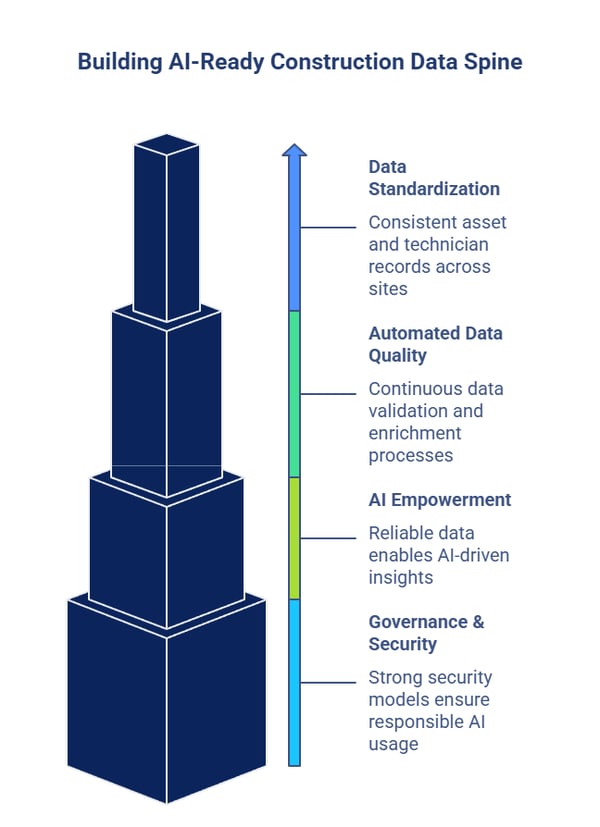
At Brysa, a leading Salesforce consulting and implementation partner, we work closely with construction organisations to turn fragmented operational data into an AI-ready foundation. Our implementation services typically start with using Salesforce Data Cloud to bring together structured and unstructured data from ERP systems and IoT sources into one connected construction data spine. Here is our typical approach:
-
Automate Field Service-Ready Records for AI-Driven Operations
We focus on making field service data reliable by design. By standardising asset histories and technician records across sites and regions, we ensure service data remains consistent and usable at scale. Field data is captured once and reused across scheduling and service execution. This reduces duplication and error and also creates AI-ready records that enable smarter scheduling and more accurate operational predictions.
-
Automate Workflows That Prepare Data for AI
We embed data quality directly into daily operations using Salesforce automation. Validation rules prevent incomplete or incorrect data at entry. But automated flows enrich records and synchronise real-time updates from the field. As a result, data quality becomes continuous and automatic, rather than a manual clean-up exercise performed after issues surface.
-
Enable Einstein & Einstein GPT with Trusted Data
We enable Einstein and Einstein GPT by grounding them in trusted, construction-specific data. This allows AI-driven recommendations, such as predictive maintenance, demand forecasting, and risk alerts, to be based on real operational context. When AI is fed with reliable data, insights become explainable, credible, and actionable for construction teams.
-
Focus on Governance, Security, and Trusted AI Foundations
We design governance and security into the data foundation from day one. Clear data lineage, role-based access controls, and strong security models ensure responsible AI usage across teams. This approach aligns with Salesforce’s trusted AI principles, enabling construction organisations to scale AI confidently and safely.
Next Steps: Build Your Construction AI Foundation the Right Way
AI success in construction is decided long before any model is deployed. Without a strong data and integration foundation, AI only amplifies fragmentation and pushes uncertainty into critical decisions. This is why the “Before AI” phase, involving building coherent, contextual, and governed data on Salesforce, truly determines outcomes. At Brysa, we help construction organisations achieve this “Before AI” phase. We help them move from disconnected systems to a unified Salesforce foundation that AI can actually rely on.
So, ready to get the “Before AI” phase right? Contact us to start the conversation.