

For decades, intuition was celebrated as the hallmark of great leadership. The instinctive ability to read markets, people, situations
A decade ago, Digital Transformation was a competitive edge for Small and Medium Businesses today, it’s the baseline with 87% of SMBs saying digital tools are critical to survival. The rise of Artificial Intelligence (AI) has reshaped customer expectations toward faster, always-on experiences. To keep up, businesses rely on Cloud Computing, Customer Relationship Management (CRM) and SaaS Platforms powered by Data Analytics and Workflow Automation to deliver seamless Customer Experience.
A modified version of this article appeared in SME News
Now, before we proceed further, let us straightaway answer the pressing question -

Why Traditional Digital Transformation Is No Longer Enough for SMBs?
Traditional digital transformation (moving to the cloud, adopting CRMs, etc.) has become the bare minimum today. Yes, these initiatives did help SMBs modernise their operations in the past. But “modernisation” is no longer a differentiation factor today.
Today’s growth challenges are different. They require systems that do more than store data and execute predefined rules. They must interpret signals and proactively drive outcomes. Without intelligence layered in, such systems often introduce complexity and limit scalability instead of enabling it.
Besides this, here are some additional reasons why we think traditional digital transformation without AI no longer cuts it today:
- Siloed tools will slow growth: Even when you move to the cloud or adopt different tools, it might not be enough if the tools are disconnected. This lack of integration can create operational bottlenecks and delays that can multiply as you scale.
- Data will remain underutilised: CRMs and business tools capture mountains of data, no doubt. But without AI, this data is rarely translated into actionable insights.
- Create operational drag: Static dashboards and rule-based automations that are not powered by AI can increase administrative overhead instead of reducing it.
What AI-Centred Transformation Truly Means?
AI-centred transformation creates a shift in how SMBs think about digital maturity. It’s not a single leap. It’s a progression from putting processes online to automating work. Here are the 4 key steps involved in this process:
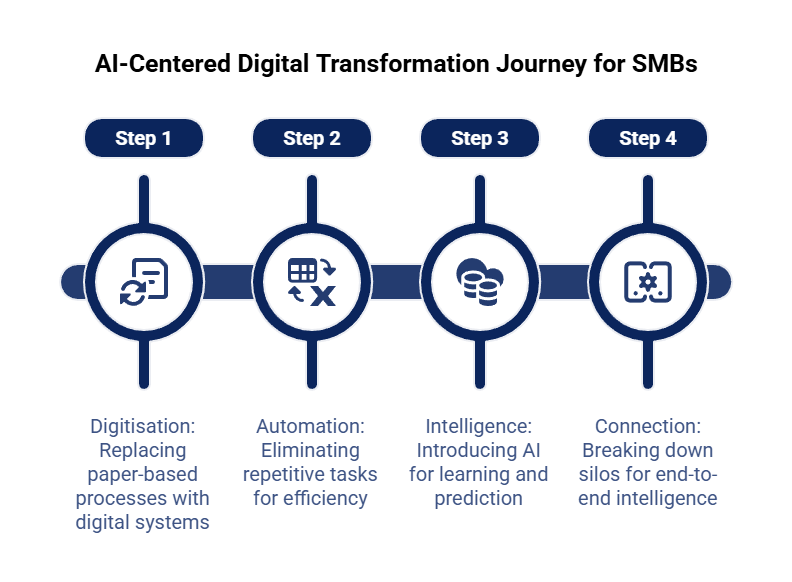
Step 1: Digitisation
This simply involves replacing paper-based or ad hoc processes with digital systems. For SMBs, this could include anything from adopting cloud CRMs to subscribing to digital marketing tools. Digitisation improves visibility and access to information. However, this step focuses on where work happens, not how intelligently it is executed. In essence, digitisation modernises operations but does not fundamentally change outcomes.
Step 2: Automation
Automation builds on digitisation by eliminating repetitive tasks. It improves the efficiency and consistency of your teams. However, traditional automation operates on predefined rules and static workflows. This limits adaptability. As business complexity grows, your automations without intelligence will lag behind constantly changing market dynamics.
Step 3: Intelligence
This is where we introduce AI into the picture. By infusing AI into your digitised and automated systems, the tool:
- Learns from data
- Identifies patterns
- Predicts outcomes
- Continuously optimises decisions.
Instead of reacting to events, AI helps you anticipate them. For instance, if AI is embedded into a lead management system, it can:
- Forecast demand
- Prioritise leads
- Recommend next-best actions
- Flag risks before they escalate
This shift transforms your systems from “reactive” to “proactive”.
Step 4: Connection
The actual power of AI lies in its ability to break down functional silos. And also on whether it can create an intelligent operating layer across your entire business operations. In this step, you use AI to connect data and workflows across different functions. It ensures that the insights generated in one function(say sales) immediately inform actions in another(marketing). This end-to-end intelligence helps you achieve consistent customer experiences and faster decision-making.
Why AI Adoption Is No Longer “Too Complex” for SMBs?
As an SMB owner, if you think AI adoption is prohibitively complex and resource-intensive, we won’t blame you. A few years ago, it was indeed reserved for only large enterprises with dedicated data science teams. But that’s not the case today. You can adopt AI incrementally and with clear business impact because of the following:
1. Cloud Platforms Have Democratised AI Access
Today’s cloud platforms can embed AI directly into your core business applications. This makes advanced capabilities available without specialised infrastructure or in-house expertise. You can leverage enterprise-grade AI for anything from analytics to forecasting by using cloud-native tools.
2. Pre-Built AI Models vs. Custom Enterprise Solutions
Instead of building complex models from scratch, you can rely on pre-trained, domain-specific AI models designed for common use cases such as sales prioritisation or demand forecasting. These models deliver faster time-to-value and eliminate the cost and risk associated with custom enterprise AI projects.
3. Low-Code and No-Code Tools Reduce Implementation Effort
Low-code and no-code platforms allow you to configure AI-driven workflows even if you or your team lacks great technical skills. This shortens implementation cycles and reduces dependency on already scarce engineering talent.
4. Subscription-Based Pricing Makes AI Affordable
AI capabilities are increasingly offered through subscription-based pricing. This shifts AI from a capital-intensive investment to an operational expense. It makes AI-based digital transformation financially accessible for SMBs. You can easily scale adoption as your needs evolve.
The Cost of Doing Nothing: What are the Risks of Delaying AI Transformation?
Delaying AI transformation has a growing and underestimated cost for you. As your competitors adopt AI to move faster and operate smarter, you, as an SMB relying on manual processes and legacy tools, risk losing customers to them.
Secondly, operational inefficiencies will continue to compound. It will drive up running costs while limiting your scalability. Finally, the absence of intelligent insights will result in poor visibility into your performance.
Over time, dependence on outdated systems leads to reactive decision-making. This will make it increasingly difficult for you to compete or even sustain growth in an AI-first market.
How Platforms Like Salesforce Help With AI-First SMB Transformation?
Salesforce plays a key role in AI-first transformation for SMBs today. It infuses intelligence directly into the systems your teams already use. Here are some ways in which Salesforce can help:
- Embeds AI across core functions: Rather than treating AI as a separate initiative, Salesforce integrates AI across your CRM, service tools, marketing platforms, and analytics software.
- Keeps data and automation as the backbone: Unified data and automation ensure AI operates on a real-time view of the customer and business operations.
- Offers AI copilots that assist, not replace teams: AI copilots support users with recommendations and summaries. At the same time, it keeps humans in control of decisions.
- Faster time-to-value with minimal IT overhead: Pre-configured capabilities and cloud-native architecture allow you to realise value quickly without heavy customisation or ongoing IT burden.
How Brysa Can Help with AI-Centred Digital Transformation?
At Brysa, we help SMBs move from intent to impact by delivering AI-centred digital transformation grounded in practical execution. As a leading Salesforce consultant, we focus on integrating AI directly into your core business workflows across sales, service, marketing, and operations. In other words, we make sure intelligence is applied where work actually happens through our tailored implementation services. So, if you are ready to make AI work for your business, contact us now.