

Every year, tech leaders promise to invest smarter in Artificial Intelligence (AI) and technology, yet budgets often disappear into tools that fail to deliver. The problem isn’t the lack of platforms like Salesforce or innovations such as Einstein AI, but the absence of clarity on where data integration, workflow automation, cloud computing, and business intelligence truly drive value. With big tech expected to invest around $650 billion in AI infrastructure by 2026, the scale of adoption is massive making it even more critical to move beyond hype and focus on real impact through digital transformation and a Single Source of Truth (SSOT).Making the most of AI isn’t about chasing trends it’s about understanding your position on the AI maturity model and applying technology where it creates measurable outcomes. In this blog, we’ll share a 5-part framework to help you turn experimentation into real value.
A modified version of this article appeared in Conversational AI News
Key Takeaways
|
The AI Maturity Model: Find out Where You Are?
Before talking about investments, there’s a more important question to answer: how ready is your organisation for AI? This is where Brysa’s simple AI maturity assessment comes in. Instead of jumping straight to solutions, this helps you diagnose your current state and plan accordingly. Brysa’s maturity model breaks AI readiness into three clear stages: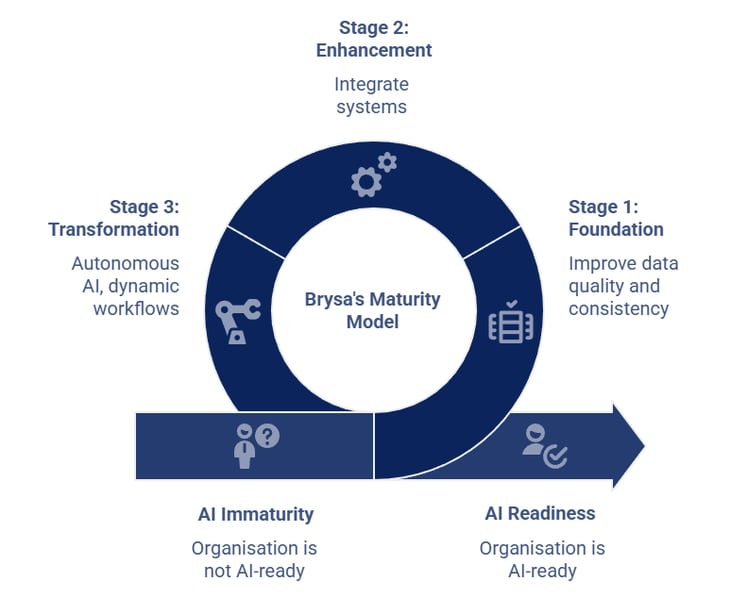
Stage 1: Foundation
You are in Stage 1 if any of the following are true:
- Your data exists, but quality issues or inconsistent definitions are common.
- Core systems (CRM, ERP, marketing, finance, analytics) are only partially integrated or rely on manual workarounds.
- Teams still spend time exporting, cleaning, copying, or reconciling data.
- Automation is limited to basic rules and scripts, not end-to-end workflows.
This is where the majority of organisations sit, even those that believe they’re already “doing AI.” At this stage, your organisation is not AI-ready yet. The real work here is making your data trustworthy and your operations predictable.
Your AI investment at this stage should focus almost entirely on data quality and operational consistency. Jumping into advanced AI here usually results in fragile pilots and disappointing outcomes.
Stage 2: Enhancement
You are in Stage 2 if all of the following are true:
- Your data is reasonably clean and standardised.
- Systems are well-integrated, but there is still manual intervention needed.
- AI is used only for forecasting and decision support.
- Intelligent workflows help teams work faster, but humans still make the final decisions.
At this stage, AI is clearly delivering value. But your organisation is still not fully ready. AI enhances how work is done, but it depends heavily on human oversight and structured processes. Most “successful AI use cases” reported by organisations live here.
The risk in Stage 2 is overconfidence. Many mistake “improved efficiency” for “true maturity”.
Stage 3: Transformation
You are only in Stage 3 if the following statements are true:
- AI systems can take actions autonomously within defined boundaries.
- Workflows adapt dynamically based on real-time data and outcomes.
- AI continuously learns and optimises without constant human reconfiguration.
- Teams focus on strategy, exceptions, and oversight rather than execution.
This is the point at which you can call yourself truly AI-ready. It is the stage where your AI investment is no longer an add-on, but rather a core operating capability. Very few organisations have genuinely crossed this threshold, despite how often it’s implied in boardroom conversations.
5-Part Framework to Making the Best Out of Your 2026 Tech and AI Investment
If you want to genuinely reach Stage 3 of AI maturity, technology alone won’t get you there. What you need is a structured way of thinking about why, where, and how to invest in AI. This isn’t a checklist or a one-time exercise. It is a five-part framework Brysa uses to help organisations move deliberately from experimentation to transformation:
1. Start with Outcomes, Not Technology
The most common mistake organisations make is investing in AI first and then searching for problems it can solve. This approach almost always leads to underused tools and disappointing ROI. If you want to progress toward Stage 3, every tech or AI investment must be mapped to a clear business outcome. Ask yourself the following questions:
- What revenue metric should this improve?
- What operational bottleneck should this remove?
- How should this change employee productivity or decision quality?
- What customer experience gap are we closing?
When outcomes are explicit, investment decisions become sharper. Trade-offs become easier. You stop chasing “AI capabilities” and start funding initiatives tied directly to growth and differentiation.
How Brysa helps: Brysa begins with outcome-driven discovery discussions before any solution design. These sessions align with you on what success actually looks like. The goal is to ensure technology decisions are anchored to measurable business impact and not hype.
2. Build vs Buy vs Partner: Make the Right Choice
Not every capability should be built in-house. Not every tool should be bought. And not every implementation should be attempted alone. This decision is strategic. And getting it wrong can set you back years.
Here’s a simple thumb rule for you:
- Build in-house when the capability is a true competitive advantage and deeply tied to your differentiation. More importantly, you have both the talent and time to sustain it.
- Buy off-the-shelf when the function is standardised and non-differentiating. This is useful for CRM workflows, analytics foundations, and service management.
- Partner for implementation when speed matters and internal expertise is limited
Most organisations underestimate the risk of execution. Partnering isn’t about outsourcing responsibility. It’s about accelerating maturity while reducing avoidable mistakes.
3. Adopt People-First Implementation for Better ROI
Technology doesn’t fail because it’s inadequate. It fails because people don’t adopt it. Even the best AI systems deliver zero value if your teams don’t trust them or know how to use them effectively. A practical rule of thumb: Allocate roughly 70% of investment to technology and 30% to people enablement.
People enablement includes:
- Role-based training rather than generic onboarding
- Contextual, in-the-flow learning instead of one-time workshops
- Clear ownership and accountability for adoption
AI maturity is as much a cultural shift as a technical one. Your teams must move from “doing tasks” to supervising and improving AI-driven systems.
How Brysa helps: Brysa embeds structured change management into our implementation services. We use role-based enablement and contextual learning to ensure adoption grows alongside capability and not months later.
4. Platform Thinking: Invest in Ecosystems, Not Islands
Point solutions are tempting. They’re fast and easy to justify. But over time, they create integration debt and operational drag. This is the exact opposite of what AI maturity requires. Reaching Stage 3 demands platform thinking:
- A shared data model across functions
- Built-in intelligence rather than bolted-on AI
- The ability to evolve workflows without constant redevelopment
This is where platforms like Salesforce make strategic sense:
- A single data foundation across sales, service, marketing, operations, and analytics
- Einstein AI embedded directly into workflows
- Low-code tools that allow continuous improvement without heavy engineering
- A roadmap of regular innovation that future-proofs investment
How Brysa Helps: Brysa brings deep Salesforce expertise across multiple clouds, ensuring your platform investments are cohesive and aligned with long-term maturity, and not just immediate needs.
5. Don’t Ignore Integration Architecture: The Make-or-Break Investment
Integration is rarely exciting and almost always underestimated. Yet it’s one of the biggest factors separating Stage 2 organisations from Stage 3 leaders. Without a strong integration architecture:
- Data becomes inconsistent
- AI insights become unreliable
- Automation breaks under scale
Stage 3 requires:
- A clear single source of truth
- Real-time or near-real-time data synchronisation
- API-first architecture that supports growth and flexibility
Integration decisions made early tend to compound either into scalable foundations or expensive technical debt.
How Brysa helps: Through our consulting services, we design integration strategies that scale from day one. We focus on clean data flows and long-term adaptability. The goal is not just to integrate systems, but to create an architecture AI can depend on as autonomy increases.
Next Steps: Turn Clarity into Confident Action
By now, you should have a much clearer view of two things: where your organisation truly stands on the AI maturity curve and what it will actually take to reach Stage 3. The next step isn’t to rush into buying tools or launching pilots. It’s to pause and sequence your investments with intent. This is also the right moment to bring in an outside perspective, one that can reduce execution risk and help you design a roadmap that turns AI ambition into sustained business impact. Brysa’s deep Salesforce expertise can help you get there faster and with far less risk. Get in touch with Brysa to start a clarity-first conversation about your 2026 AI roadmap.