

Companies investing in powerful platforms like Salesforce Marketing Cloud often assume the technology alone will solve their customer engagement challenges. But hear us out - when the results fall short, the issue is rarely the platform itself. The real problem is orchestration. Customer data lives in one system. Campaigns in another. Sales teams operate with different priorities. Automation simply ends up becoming a tangled web of disconnected journeys.
The result is utter chaos disguised as personalisation. Over the years, we’ve witnessed many organisations rush into marketing automation without first determining how customer journeys should actually function across channels and stages of the lifecycle.In this blog, we will help you design scalable and automated customer journeys in Marketing Cloud without creating unnecessary complexity that slows your teams down or weakens customer experience.
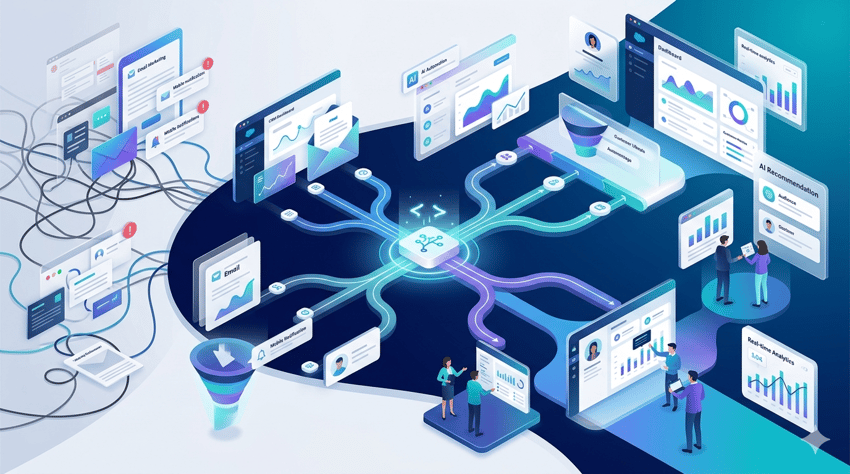
What is Customer Journey Automation?
It is a structured sequence of interactions that guides your customers through different stages of their relationship with your brand without requiring constant manual intervention. So, instead of sending one-size-fits-all campaigns, you can use automation to deliver personalised:
- Messages
- Recommendations
- Reminders
- Experiences
All based on customer behaviour and real-time actions. Platforms like Salesforce Marketing Cloud can help orchestrate these journeys. They ensure that your customers receive the right message at the right time. End result - better operational efficiency and better customer experience.
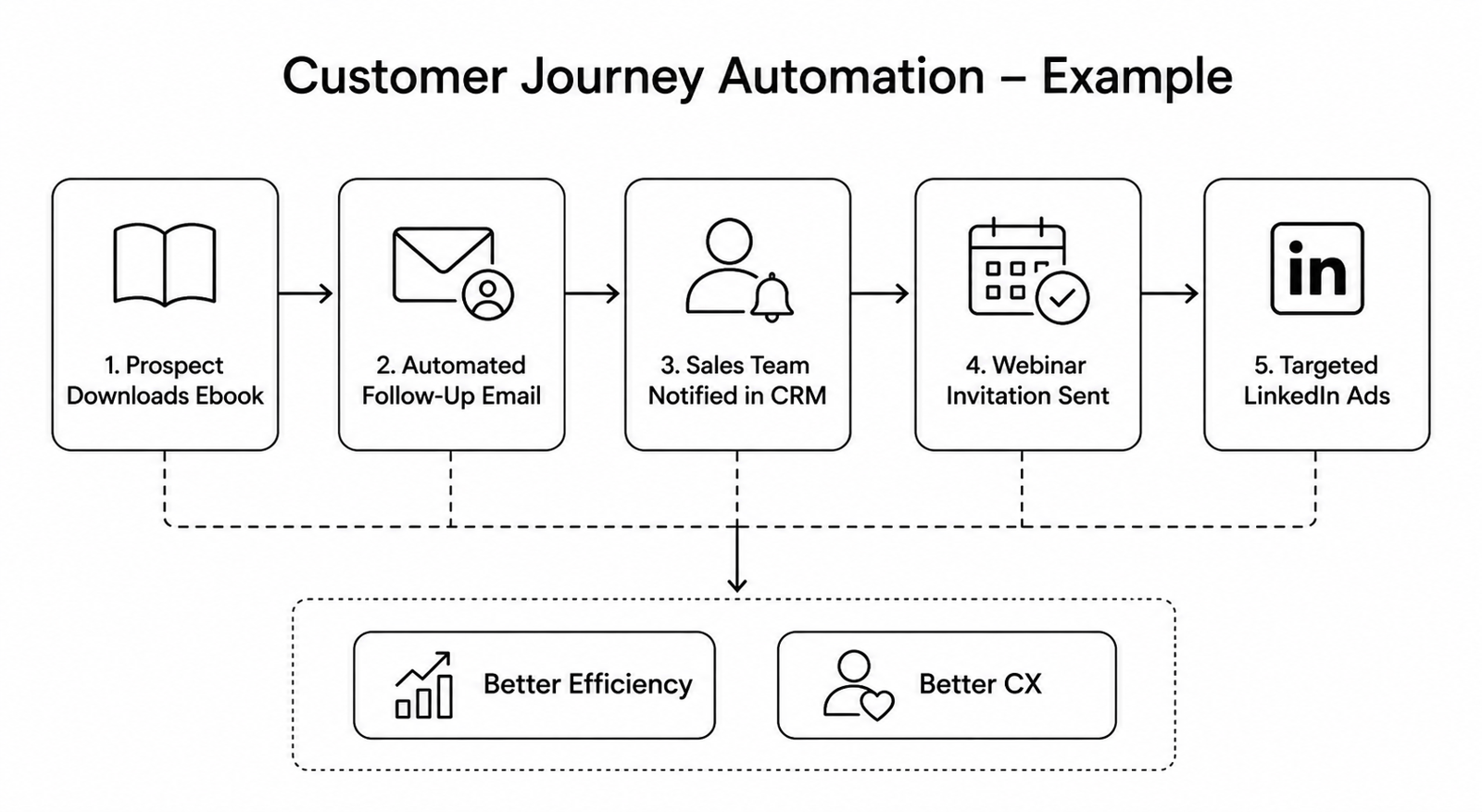 For example, a prospect downloads an ebook from your website. Marketing Cloud automatically triggers a personalised follow-up email sequence and notifies your sales team in Salesforce CRM. It then sends an invitation to a relevant webinar a few days later and finally displays targeted LinkedIn ads showcasing related products based on the prospect’s industry and interests.
Why Marketing Operations Become Chaotic Without Well-Designed Customer Journeys?
Firstly, marketing operations rarely become chaotic overnight. In most cases, the complexity builds gradually as you add new tools, channels, campaigns, and customer touchpoints. Slowly, your teams will begin operating in silos, and data will become fragmented across systems. Your marketers will spend more time managing processes than improving customer engagement.
Without well-designed customer journeys, even advanced platforms like Marketing Cloud can't help you grow. Instead of delivering seamless experiences, it will create disconnected interactions that hurt both yur operational performance and customer trust. Here are some potential repercussions:
- Disconnected tools and platforms → Fragmented execution: When your customer data, campaign management, analytics, and sales operations exist across disconnected systems, your teams will struggle to create unified customer experiences. This will lead to gaps in communication and inconsistent execution across channels.
- Manual campaign management → Inefficiency: Without automated workflows and journey orchestration, your marketing teams will spend significant time manually launching campaigns and coordinating communications. This will slow down your campaign execution.
- Poor data visibility → Weak decision-making: When you lack a centralised view of customer behaviour and campaign performance, it becomes difficult to make informed marketing decisions. Your teams will rely on incomplete data. This will invariably lead to ineffective targeting and missed opportunities.
- Lack of automation → Slow execution: Modern customers expect timely and relevant engagement. Without automation, you will struggle to respond to customer actions in real time. This will cause delays in communication and lower engagement rates.
- Inconsistent messaging → Poor customer experience: If different teams and channels communicate without alignment, your customers will receive mixed messages throughout their journey. This will create unnecessary confusion and weaken the overall brand experience.
How to Design Scalable Customer Journeys for Marketing Cloud?
Designing scalable customer journeys is not simply about automating emails or launching campaigns. It is about creating a connected system that delivers personalised customer experiences consistently across every touchpoint without increasing operational complexity.
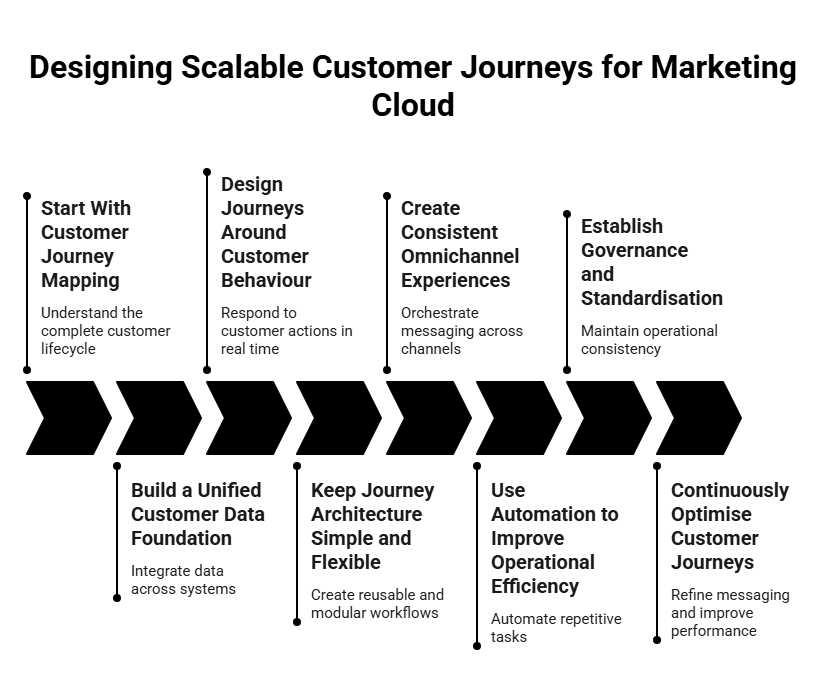
Now that you have already invested in Marketing Cloud, you are halfway there. All that is left is strategically designing seamless customer journeys using the right data foundation and operational structure. Here are the steps to design scalable customer journeys for Marketing Cloud:
Step 1: Start With Customer Journey Mapping
It all begins with understanding your customer lifecycle. Many organisations focus only on individual campaigns instead of analysing how customers interact with the brand across different stages. You should instead map every stage of the customer journey, including awareness, consideration, onboarding, engagement, retention, and re-engagement. Understanding customer expectations, pain points, and decision triggers at each stage helps you create journeys for Marketing Cloud that feel connected instead of fragmented.
Step 2: Build a Unified Customer Data Foundation
Journeys cannot scale effectively when your customer data exists across disconnected systems. We have seen marketing, sales, ecommerce, analytics, and customer service teams often operate using separate datasets. This only results in inconsistent communication and poor personalisation.
Instead, when you integrate customer data across systems, it will help create a single source of truth and a unified customer view. This allows Marketing Cloud to trigger journeys based on real-time customer behaviour instead of static audience lists. You can then deliver more personalised and timely experiences while improving visibility across teams.
Step 3: Design Journeys Around Customer Behaviour
Modern customers expect you to respond to their actions in real time. This is why scalable journeys should focus on customer behaviour rather than one-size-fits-all campaigns. Journeys should automatically adapt based on different actions such as:
- Downloading content
- Abandoning a cart
- Visiting pricing pages
- Making a purchase
- Renewing a subscription
- Becoming inactive
Behaviour-driven automation helps you deliver relevant communication at the right moment while reducing manual effort.
Step 4: Keep Journey Architecture Simple and Flexible
One of the biggest reasons marketing operations become difficult to scale is overly complicated automation structures. Large workflows with excessive branching logic and duplicated processes quickly become difficult to manage.
Scalable customer journeys are generally modular and flexible. You should create reusable workflows and structured automation logic that can evolve as your business grows. This improves operational agility while making future optimisation easier.
Step 5: Create Consistent Omnichannel Experiences
Customers interact across multiple channels, including email, social media, websites, mobile apps, SMS, and customer support platforms. If these interactions feel disconnected, the customer experience weakens. Scalable customer journeys require strong orchestration across all these channels. This will ensure that experience remains consistent throughout the customer lifecycle.
Step 6: Use Automation to Improve Operational Efficiency
As your businesses grow, manual campaign execution becomes unsustainable. Your marketing teams might spend too much time managing repetitive tasks instead of focusing on strategy and optimisation. You should instead automate:
- Audience segmentation
- Lead nurturing
- Onboarding workflows
- Follow-up communication
- Re-engagement campaigns
- Reporting processes
Operational automation reduces inefficiencies while allowing your teams to scale customer engagement more effectively.
Step 7: Establish Governance and Standardisation
Without governance, automation can quickly become chaotic. As different teams from your business create journeys independently, you will quickly encounter duplicate workflows and unclear ownership structures. When you establish standards for everything from naming conventions to approval workflows, you end up maintaining operational consistency even when automation scales rapidly.
Step 8: Continuously Optimise Customer Journeys
Customer behaviour changes constantly. This means your customer journeys will never remain static. You should regularly analyse engagement metrics like conversion rates and behaviours like drop-off points to identify improvement opportunities. Continuous customer journey optimisation helps you refine messaging and strengthen personalisation. This will ultimately increase overall journey performance.
The Role of AI in Automating Customer Journeys
Artificial Intelligence is already playing a significant role in designing and managing customer journeys in platforms like Marketing Cloud. Traditional automation relied heavily on predefined workflows and manual decision-making. But when AI enters the picture, journeys become far more dynamic and predictive. For instance, instead of simply responding to customer actions, AI can:
- Analyse behavioural patterns
- Predict intent
- Recommend next-best actions
- Optimise communication timing
- Personalise content
This helps you move beyond rule-based automation and create experiences that feel more relevant and contextual in real time.
AI also plays a major role in improving your operational efficiency and decision-making within customer journey orchestration. For instance, you can use AI-powered insights to identify:
- High-converting audience segments
- Detect churn risks
- Automate lead scoring
- Optimise campaign performance
- Improve customer engagement across channels.
Features such as predictive analytics, intelligent segmentation, automated recommendations, and AI-driven content personalisation can help your marketing teams reduce manual effort while scaling customer engagement more effectively. As customer expectations continue to evolve, AI is becoming essential for businesses looking to create more adaptive customer journeys without increasing operational complexity.
How Can Brysa Help Build Scalable Customer Journeys?
As a trusted Salesforce implementation consulting partner, Brysa helps you transform Marketing Cloud from a complex automation platform into a powerful customer engagement ecosystem. In our MCAE Quick Start package, we focus on business-first implementation strategies that align your marketing automation with operational goals and long-term growth plans. From designing advanced customer journeys and integrating customer data systems to optimising automation workflows and improving campaign performance, we help you build AI-backed and intelligent marketing operations that reduce complexity and increase efficiency. Ready to build scalable and automated customer journeys for Marketing Cloud? Contact us now.