

For many organisations, the gap between experimenting with AI and operationalising it remains wide. The challenge is never around lack of tools or talent. It has always been about clarity on how to implement it the ‘right way’. This is understandable considering digital transformation with AI requires a deliberate rethinking of workflows and regeneration of decision-making frameworks. These, more often than not, lead to fragmented systems and unsustainable dependencies. Companies that succeed are those that treat AI as a critical capability and engage a consultant when they lack the resources to do it in-house. By combining technical expertise with business context, AI transformation consulting helps them move beyond pilots and proofs of concept to responsible AI adoption.
Key Takeaways
|
Understanding the Role of Ad Ops in Modern Media Organisations
Ad operations today go far beyond simply “launching campaigns.” Ad ops teams are responsible for:
- Managing a complex stack of platforms, including DSPs, SSPs, ad servers, and analytics tools
- Ensuring that campaigns run accurately
- Making sure that budgets are spent efficiently
- Capturing performance data in real time.
In an environment where even minor setup errors can lead to wasted spend or misfired targeting and coordination across systems, ad ops becomes a critical component for smooth operations.
Equally important is the efficiency of the workflows that support these operations. When processes are fragmented or manual, teams face delays and limited scalability, which directly impact performance. Put simply,
Without ad ops, you face:
- Underdelivered campaigns
- Revenue leakage
- Reporting discrepancies
- A poor experience for both advertisers and end users.
While a well-structured ad ops, you experience
- Faster go-to-market
- Better optimisation cycles
- More reliable outcomes
Two Types of Ad Ops Models
Broadly speaking, ad ops can either be built in-house or outsourced to specialised partners, each offering a distinct set of advantages and trade-offs. Let us understand both types.
1. The In-House Ad Ops Model
The in-house ad ops model gives you complete ownership over your campaigns and execution processes. This makes it a good choice for teams that prioritise control and alignment. With ad ops sitting internally, collaboration with different teams becomes more seamless, supporting faster communication and tighter feedback loops. You can tailor workflows and maintain direct oversight of data and decision-making. This is valuable particularly for those with complex or highly customised campaign requirements. But there are numerous challenges you might encounter in this model:
- High hiring and retention costs, especially for skilled programmatic and platform specialists
- Continuous training and upskilling are required to keep pace with evolving ad tech
- Significant investment in tools and ongoing tech stack maintenance
- Limited scalability during peak demand or sudden spikes in campaign volume
- Increased risk of operational bottlenecks due to dependency on internal bandwidth
2. The Outsourced Ad Ops Model
This model gives you access to specialised expertise without the overhead of building and managing an internal team. Agencies and ad ops partners bring experienced professionals who are already trained across platforms. Outsourced ad operations management helps in faster execution and supports you with better optimisation practices. This model also reduces the burden of hiring, infrastructure, and continuous training, while benefiting from standardised workflows and proven performance frameworks. Many outsourced teams operate across time zones, offering near 24/7 support, which helps accelerate turnaround times and maintain campaign continuity. But there are a few downsides to this model, especially when you don’t have the right partner:
- Communication and coordination gaps across teams and time zones
- Dependency on external partners for execution and turnaround
- Initial onboarding and alignment are required to match business goals and processes
Successful teams do not outsource ad ops purely to cut costs. They do it to bring in optimisation maturity and improve performance more efficiently than what most in-house teams can achieve alone.
In-House vs Outsourced Ad Ops: Comparison
To decide between in-house and outsourced ad ops better, it helps to compare both models side by side across the factors that matter most to performance and scalability. The table below breaks down how in-house and outsourced ad ops differ across different factors:
| Factor | In-House Ad Ops | Outsourced Ad Ops |
| Control | Full control over campaigns, data, and processes | Limited control, shared with an external partner |
| Expertise | Depends on internal hiring and training | Access to specialised, experienced teams |
| Cost Structure | High fixed costs (salaries, tools, training) | Lower upfront costs, more variable pricing |
| Scalability | Limited by internal bandwidth and hiring speed | Highly scalable, can handle volume spikes easily |
| Speed of Execution | Can be slower during peak periods | Faster execution due to dedicated resources |
| Technology & Tools | Requires investment and maintenance | Often included or optimised by the partner |
| Workflow Efficiency | Varies based on internal maturity | Standardised, proven workflows |
What Successful Teams Do Differently: Adopt a Hybrid Model
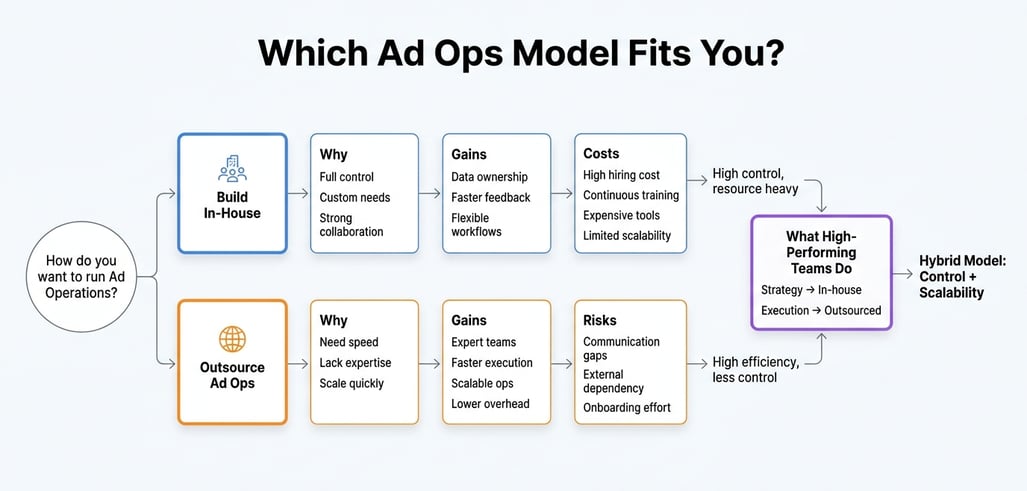
Successful teams rarely treat ad operations as an either-or decision. Instead, they adopt a hybrid model where strategic ownership stays in-house while execution is selectively outsourced. This allows internal teams to focus on high-impact areas such as planning, budget allocation, and performance strategy, while external partners handle campaign trafficking, QA, and day-to-day optimisation. The result is a more efficient division of responsibilities, where each function is handled by the team best equipped to deliver results.
Platforms like Salesforce Media Cloud further strengthen this model by enabling better coordination between internal and external teams. With a unified data model and workflow automation, you can maintain visibility and ensure alignment across different functions.
This approach also gives you the flexibility to scale without long-term overhead. During peak seasons or high campaign volumes, outsourced partners can quickly ramp up support, while specialised experts can be brought in for complex technical needs. High-growth companies in particular prefer this model because it combines control with agility, enabling them to move faster and adapt to changing demands without being constrained by internal bandwidth or fixed costs.
How Brysa Supports High-Performance Media Operations?
Instead of treating ad ops as a standalone function, Brysa takes a business-first approach. We align media execution with broader RevOps and go-to-market strategies. This ensures that every campaign is not only delivered efficiently but also contributes meaningfully to pipeline growth and revenue performance.
At the core of this approach are process-driven frameworks designed to bring consistency and transparency to ad operations. We focus on creating a unified ecosystem where data flows smoothly, and insights drive continuous optimisation. Whether you choose a fully outsourced or hybrid model, we provide flexible support structures tailored to your needs. Want to know more about how we can help? Contact us now.