

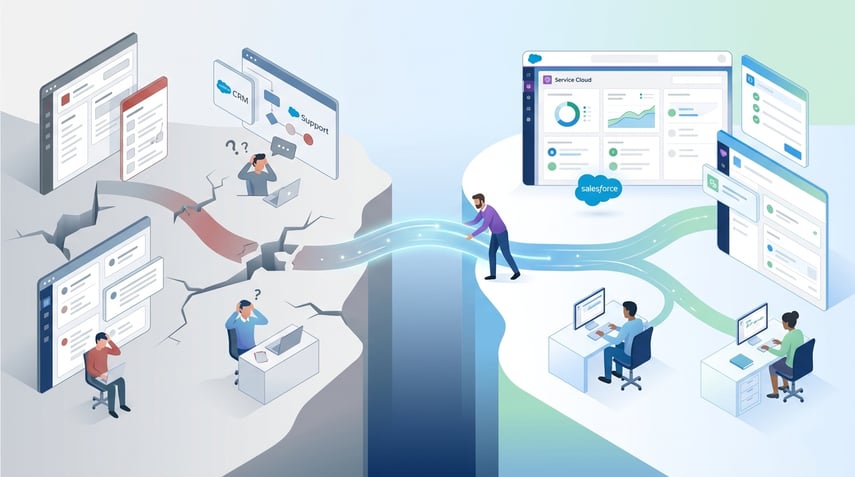
For many businesses, Service Cloud forms the backbone of their customer support operations. The platform offers streamlined case management and more consistent service experiences. Yet, despite its powerful capabilities, many implementations fall short of delivering the expected return on investment. Teams struggle with low adoption. Service operations get riddled with disconnected subprocesses that fail to reflect real-world operations.
The issue, more often than not, isn’t the platform itself but how it has been implemented. It is largely attributed to a “hidden gap” between business needs and system design that quietly undermines your entire Service Cloud investment. In this guide, we will deep dive into this hidden gap and also explain how the right consultant can fix it.
Key Takeaways
|
Why Do Service Cloud Implementations Fail: Expectations vs Reality
Service Cloud implementations are usually driven by 3 core promises:
- Intelligent automation
- Faster case resolution
- Seamless customer experience
On paper, the platform is fully capable of delivering all three. Stakeholders experience reduced response times and improved service quality initially. Their agents quickly feel empowered and resolve issues efficiently with the help of automation and AI-driven insights.
But, in reality, many implementations slowly fall into the trap of fragmented workflows that are replete with manual interventions and poor user adoption. This is because processes are either over-engineered or fail to reflect how support teams actually work on the ground.
This creates a clear disconnect between what the system is capable of and how it is used in day-to-day operations. Without aligning the implementation to real business needs, even the most powerful features of Service Cloud remain underutilised.
Also, with platforms like Salesforce Agentforce and growing AI capabilities in Salesforce Service Cloud, the stakes are even higher. A poorly implemented system doesn’t just impact current operations; it limits your ability to leverage AI and intelligent support in the future.
The Hidden Gap in Service Cloud Implementations: When Does It Emerge?
The hidden gap in Service Cloud implementations doesn’t surface all at once. It begins subtly during the early stages of the project. It is often visible when your teams prioritise system configuration over a deep understanding of business processes. While the setup may appear technically sound, it lacks alignment with how customer support actually functions.
Over time, this misalignment grows. It creates friction for your agents and limits the platform’s ability to deliver meaningful outcomes. This gap typically emerges due to a combination of overlooked factors, such as the following:
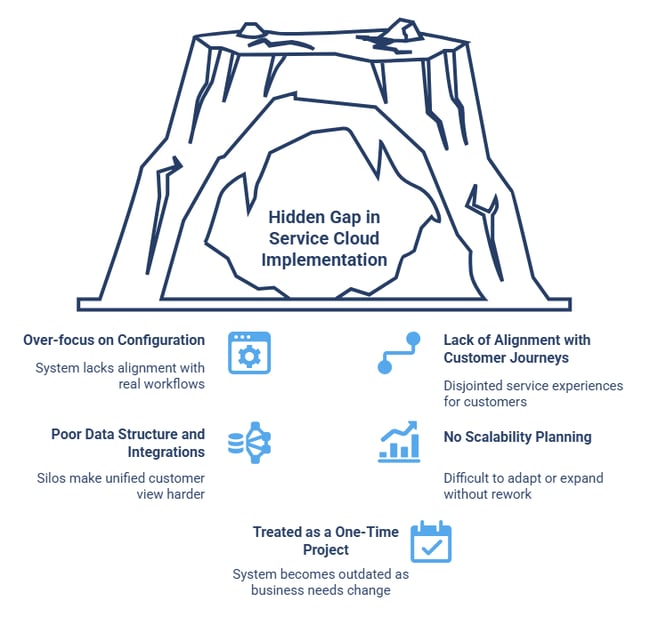
- Over-focus on configuration instead of business processes: Teams concentrate on features and automation rules without mapping them to real workflows. This leads to a system that looks good but doesn’t work well.
- Lack of alignment with customer journeys: The implementation fails to reflect how customers actually engage with the business across touchpoints. This results in disjointed service experiences.
- Poor data structure and integrations: Inconsistent data models and weak integrations create silos. This makes it harder to get a unified view of the customer and automate effectively.
- No scalability planning: The system is built for current needs without considering future growth. This makes it difficult to adapt or expand without rework.
- Treated as a one-time project: Organisations fail to continuously optimise and evolve the system. This causes it to become outdated as business needs change.
Business Impact of Poor Implementation
Poor Service Cloud implementation doesn’t just create technical inefficiencies. It directly impacts business performance, often in ways that compound over time. What starts as minor workflow issues or adoption challenges can quickly translate into frustrated teams and dissatisfied customers. Instead of acting as a growth enabler, the system becomes a bottleneck that limits both operational efficiency and customer satisfaction.
The business impact typically shows up across multiple areas:
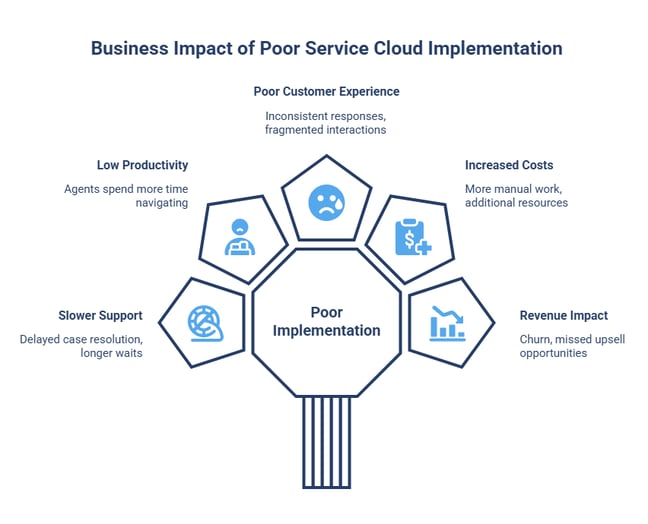
- Slower support and response times: Inefficient workflows and a lack of automation delay case resolution. This leads to longer wait times for customers.
- Low agent productivity: Agents spend more time navigating the system or handling manual tasks instead of focusing on meaningful customer interactions.
- Poor customer experience: Inconsistent responses and delays result in a fragmented and frustrating experience for customers.
- Increased operational costs: More manual work and dependency on additional resources drive up the overall cost of support operations.
- Revenue and retention impact: Poor service experiences lead to churn and missed opportunities for upsell or cross-sell.
How to Optimise Service Cloud Implementation? What High-Performing Teams Do Differently
High-performing teams treat Service Cloud not as a static tool, but as a dynamic system that evolves with their business. They focus less on just “setting it up” and more on “making it work” for agents and customers alike. The difference lies in how intentionally they align technology with real-world operations and continuously refine it over time. Here are 6 things they do differently:
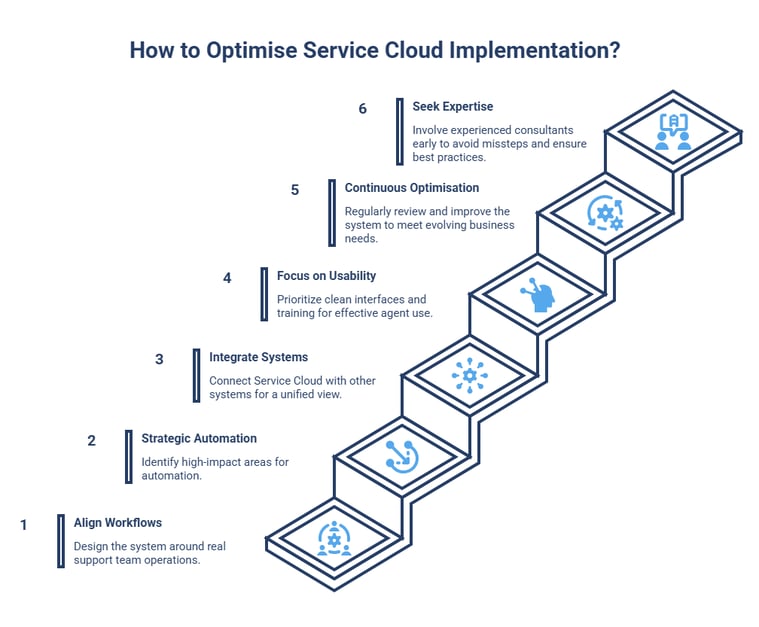
- Align Service Cloud with real workflows: They design the system around how their support teams actually operate. This ensures processes are practical and grounded in day-to-day use.
- Use automation strategically: Instead of over-automating, they identify high-impact areas where automation genuinely reduces effort and speeds up resolution without adding complexity.
- Integrate systems across the ecosystem: They connect Service Cloud with CRM, support tools, and operational systems to create a unified view and eliminate data silos.
- Focus on usability and adoption: They prioritise clean interfaces and proper training to ensure agents actually use the system effectively.
- Continuously optimise and evolve: They treat implementation as an ongoing process. They regularly review performance and make improvements to keep the system aligned with business needs.
- Seek help at the right time: High-performing teams know when to bring in the right expertise instead of trying to fix everything internally. They involve experienced consultants early to avoid costly missteps and ensure best practices are followed from the start.
AI Readiness Layer: What Most Implementations Miss
Most Service Cloud implementations are designed to solve immediate operational challenges, not to support future intelligence. However, with the rise of AI capabilities like Salesforce Einstein and platforms like Agentforce, the foundation you build today directly determines how effectively you can adopt AI tomorrow. If your system is built on fragmented data and workflows, AI won’t drive efficiency; it will simply expose and amplify existing inefficiencies.
What most organisations miss is that AI readiness is not about adding AI later; it is about structuring your implementation correctly from the start. This means having clearly defined case lifecycles, integrated systems across the customer journey, and standardised processes that AI can learn from and optimise. When these elements are in place, AI can enable capabilities like intelligent routing, automated case resolution, and agent copilots. Without them, even the most advanced AI tools struggle to deliver meaningful impact.
How the Right Consultant Fixes the Gap?
The right Service Cloud consultant doesn’t just “set up” the system. They identify gaps between your business processes and how the platform is being used. They then systematically fix them to drive efficiency and measurable outcomes. They fix the gap by performing the following activities:
- Audit of Business processes and workflow: They map your current support workflows and align Service Cloud with how your teams actually operate.
- KPI-driven implementation: They make sure every configuration is tied to clear metrics like resolution time and CSAT to ensure tangible business impact.
- Scalable architecture and integrations: They design a future-ready setup that integrates seamlessly with your CRM, support tools, and operational systems without creating silos.
- Automation with clear use cases: Instead of over-automating, they implement targeted automation for high-impact scenarios like case routing and escalations.
- Training and change management: They ensure that your teams adopt the system effectively through structured training and continuous support, reducing resistance.
- Future-ready implementation: They ensure your implementation is structured in a way that supports future AI adoption, rather than requiring a costly rebuild later.
How Brysa Can Help?
At Brysa, we go beyond traditional Salesforce Service Cloud consulting by focusing on outcomes that truly move the needle. Our Salesforce Service Cloud Quick Start package combines omnichannel support setup with intelligent workflows to streamline your service operations and eliminate inefficiencies. By enabling self-service capabilities and designing workflows around real customer behaviour, we help improve response times and boost your agent productivity.
Every Service Cloud solution we build is rooted in a business-first approach, ensuring its setup aligns with your goals and delivers measurable impact.
Our commitment to scalability also means we don’t just implement Service Cloud; we ensure it becomes a base for your AI-led customer experience transformation.
So, if your Service Cloud isn’t delivering results, it’s time to rethink your approach and partner with us. Contact us now.