

The collapse of FTX, led by Sam Bankman-Fried, exposed critical limitations in finance and accounting systems for fast-growing businesses. John Ray III noted that while QuickBooks is effective for small businesses, it falls short at scale. In fact, 62% of growing SMBs report delays in Financial Reporting due to entry-level accounting systems. As businesses expand, they require advanced capabilities like Financial Automation, scalability, and real-time insights often supported by robust ERP Systems and platforms like Accounting Seed built on Salesforce.Modern financial operations demand more than basic tools they require support for Multi-Entity Accounting and alignment with Revenue Operations. Without this, entry-level systems like QuickBooks struggle to keep up with the increasing complexity of growing organisations.
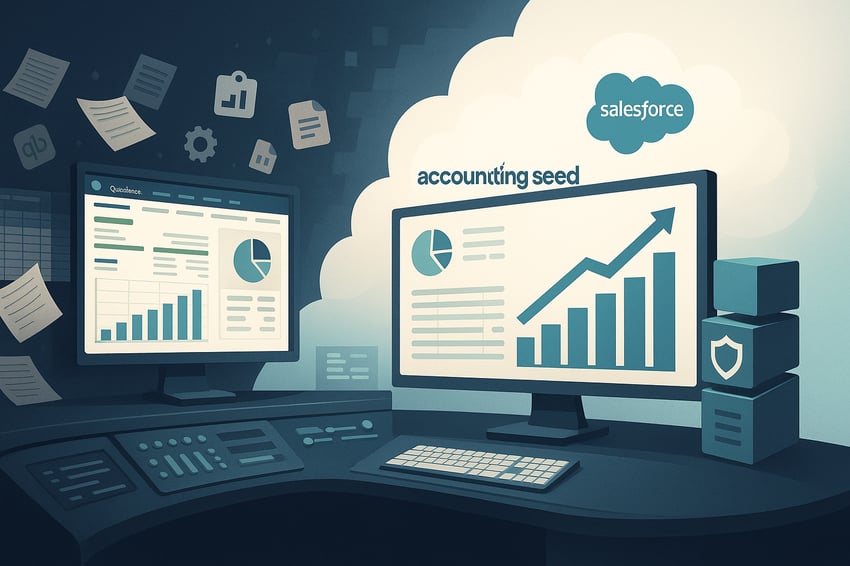
This is where accounting and finance software like Accounting Seed and Salesforce come in. Accounting Seed is a cloud-based accounting software that offers a seamless, scaleable process for businesses. It is built on the Salesforce platform, which is considered as the most innovative business enablement technology platform. This allows businesses to have a single platform for all their operations, from sales and marketing to accounting and customer service.
One of the biggest advantages of Accounting Seed is its ability to automate many of the manual processes that are required for accounting. For example, it can automatically generate invoices, reconcile bank statements, and generate financial reports. This not only saves time but also reduces the risk of errors.
Another advantage of Accounting Seed is its ability to scale (read the detailed comparison between Accounting Seed and its competitors like QuickBooks, Sage and Xero). As a business grows, it can easily add more users, modules, and features to the software. This allows businesses to keep pace with their growth and ensure that their accounting processes are always up-to-date.
When Salesforce is integrated with Accounting Seed, businesses can get a complete view of their financial performance and customer interactions (read our case study of how we improved efficiency by almost 30% with seamless integration). This allows them to make better-informed decisions and improve their bottom line.
In conclusion, Accounting Seed and Salesforce are powerful finance and accounting software that offer businesses the ability to save time and money, while also providing the scalability and automation needed for fast-growing medium-sized businesses. They are a great alternative for businesses that have outgrown QuickBooks and are in need of more advanced features to manage their financials.
If your business is looking to implement Accounting Seed and Salesforce, Brysa consulting can help. Our team of experts specializes in Accounting Seed consulting, Salesforce finance consulting, and Salesforce implementation. We can help you with every step of the process, from planning and implementation to training and ongoing support. Contact us today to learn more about how we can help your business grow with Accounting Seed and Salesforce.