

Did you know that Slack is used by over 950,000 organisations worldwide as of 2025? From small startups to Fortune 100 companies, it has become one of the most influential internal communication software alongside Microsoft Teams. This is understandable given that it facilitates faster communication and better cross-functional collaboration among teams.
Yet, for so many businesses, instead of improving productivity, Slack slowly becomes another layer of workplace distraction. We have seen many Slack implementations failing to deliver long-term value. Now, this is not because Slack for business is ineffective, but because most teams approach the implementation as a software deployment exercise rather than a full-fledged communication strategy.
In this blog, we will understand why most Slack implementations fail and how to build a Slack ecosystem that genuinely improves collaboration across your teams.

Why Many Slack Implementations Fail?
Here’s the truth: whenever we talk about the failed implementation of a highly successful software(any software), the problem is rarely the tech. It is usually the lack of a clear implementation blueprint and alignment with how teams actually work. Here are some common reasons why many Slack implementations fail: 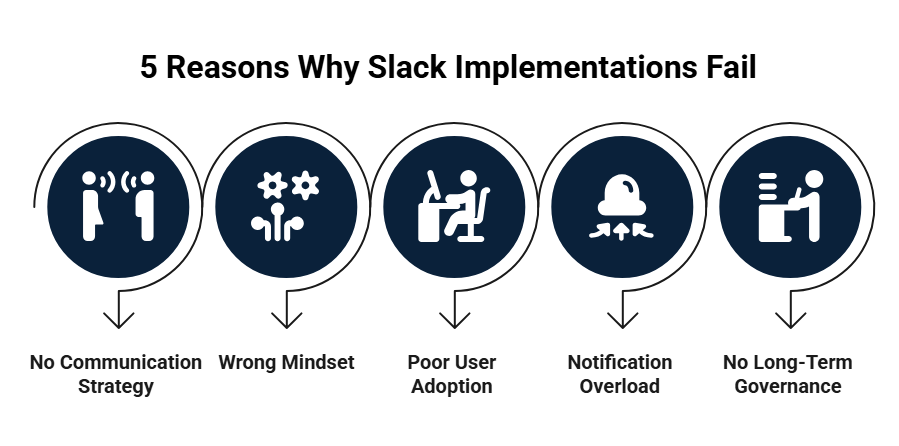
1. No Clear Communication Strategy
Many companies implement Slack without defining how it should be used across teams. More often than not, employees end up creating random channels. Duplicate conversations happen everywhere, and important updates get lost.
End Result: Without clear rules around channel structure and response expectations, Slack quickly becomes noisy and unmanageable.
2. Wrong Mindset - “Slack is Just a Messaging Tool”
Many teams use Slack only for chatting. They do not build workflows around it. Remember - a powerful digital workplace platform like Slack works best only when it is integrated with project management tools, CRMs, customer support platforms, and automation systems.
End Result: Without integration with other internal systems, your teams will continue switching between tools. This considerably reduces the efficiency Slack is supposed to build over time.
3. Poor User Adoption Across Teams
Many businesses struggle to get employees to consistently use Slack. This mostly happens when teams are not properly trained or shown how Slack improves their daily work. Put simply, employees fail to see the clear value of the platform without proper onboarding.
End Result: Teams continue relying on emails or other disconnected communication methods.
4. Notification Overload and Channel Chaos
Not just Slack, notification overload is a common issue in any communication platform. Users quickly become overwhelmed when they receive a barrage of messages every now and then. Excessive tagging and constant notifications usually reduce productivity instead of improving it.
End Result: Without proper governance and moderation, employees begin muting channels or ignoring important messages altogether.
5. No Long-Term Ownership or Governance
Many companies focus heavily on launching Slack but ignore ongoing management. Successful Slack environments require dedicated ownership and regular audits. They also need frequent channel cleanups and policy updates.
End Result: Without long-term governance, the workspace becomes cluttered over time. This makes collaboration inefficient and frustrating for teams.
What Successful Slack Implementation Looks Like?
A successful Slack implementation is one where the 4Cs work in tandem:
- Communication
- Collaboration
- Connected Operations
- Centralised Workflows
Once the 4Cs are working together, instead of becoming another source of distractions, Slack becomes a central hub that improves productivity and keeps your teams in sync across departments. Here are some typical characteristics of a successful Slack implementation:
✅ Focuses on workflows and not just messaging
✅ Aligns communication with your business operations so that your teams collaborate in a more organised and outcome-driven way
✅Uses structured channels and governance policies to reduce clutter
✅Integrates with CRMs like Salesforce and project management tools
✅Reduces dependency on emails and disconnected communication tools
✅Improves visibility into projects and team activities in real time
✅Encourages higher employee adoption through training and clear usage guidelines
How to Implement Slack the “Right Way”?
The trick is to approach Slack strategically by focusing on communication structures, integrations, governance, and long-term adoption rather than simply rolling it out company-wide without a plan. Here are 6 basic steps to implement Slack the right way: 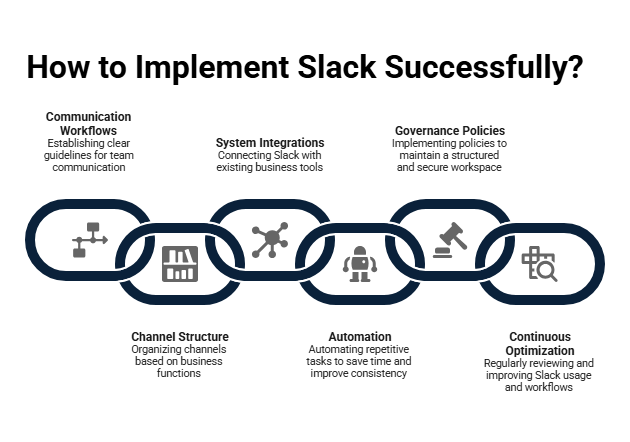
Step 1: Define Clear Communication Workflows
Before implementation, you should establish clear guidelines for how your teams communicate on Slack. This includes deciding:
- Which conversations belong in channels
- When to use direct messages
- How approvals will happen
- How information should flow across departments.
Such clear workflows and rules will reduce confusion later on and improve accountability considerably.
Step 2: Structure Channels Based on Business Functions
Well-organised channels are a small but important factor for improving the ROI of your Slack implementation. Instead of creating random channels, you should structure Slack channels around departments, projects, clients, workflows, and operational priorities. A clean channel architecture makes collaboration much easier and prevents communication silos.
Step 3: Integrate Systems and Tools Effectively
Slack delivers the most value when connected with your existing business systems, such as CRMs, project management platforms, HR tools, support software, and marketing applications. For instance, Salesforce integration helps your teams receive real-time CRM updates, manage approvals, collaborate on opportunities, resolve cases faster, and access customer insights directly within Slack without switching platforms. Essentially, Slack becomes a central hub for collaboration and decision-making.
Step 4: Use Automation for All the Repetitive Tasks
You can automate approvals, reminders, ticket creation, reporting updates, onboarding workflows, notifications, and many other recurring operational processes directly within Slack to save time and improve consistency. When integrated with Salesforce, you can also automate lead notifications, opportunity updates, case escalations, and approval workflows in real time.
Step 5: Implement Governance and Usage Policies
Without governance, Slack environments quickly become cluttered and difficult to manage. You should establish policies for channel creation, naming conventions, app permissions, security settings, data retention, and communication etiquette to maintain a structured and secure workspace.
Step 6: Continuously Optimise Adoption and Workflows
Slack implementation is not a one-time setup. You should regularly review adoption levels, employee feedback, workflow efficiency, and collaboration patterns to identify improvement opportunities. Ongoing optimisation ensures Slack continues to support your evolving business needs and your teams become truly Slack Smart.
What the Next Generation of Workplace Collaboration Will Look Like?
The next generation of team collaboration software will move far beyond simple messaging and video meetings. Businesses are rapidly shifting toward automation-first communication models where routine updates, approvals, notifications, and operational workflows happen automatically in the background. AI-driven workflow management software will play a major role in helping teams prioritise tasks, surface relevant information, predict operational bottlenecks, and streamline decision-making in real time. Instead of employees constantly switching between platforms, collaboration tools will evolve into intelligent digital workspaces that proactively support productivity and execution.
Future workplaces will also be built around connected collaboration ecosystems where platforms like Slack, Salesforce, project management tools, customer support systems, and analytics solutions work together seamlessly. Businesses will increasingly rely on intelligent workplace analytics to gain insights into team productivity, workflow efficiency, customer interactions, and operational performance. As organisations continue to scale globally, the focus will shift toward creating scalable digital operations that support distributed teams and faster business execution without adding operational complexity.
How Can Brysa Help?
With our Slack Quick Start Package, we help you move beyond basic messaging by creating structured communication environments, integrating Salesforce with Slack, automating repetitive workflows, and establishing governance best practices that support long-term scalability. Whether you are implementing Slack for the first time or looking to optimise an existing setup, we work closely with your teams to ensure Slack becomes a true operational hub for your business. Contact us today to learn how we can help you build a smarter and more connected digital workplace.