

So, the next phase of enterprise automation must address this tension head-on. Automation should expand judgment and adapt to people—not the other way around. This is where Salesforce comes into the picture. By combining Business Process Automation, intelligent Workflow Automation, and Low-Code Automation tools like Salesforce Flow, powered by Artificial Intelligence within a robust CRM (Customer Relationship Management) ecosystem, Salesforce enables organisations to scale automation without compromising human potential—driving meaningful Digital Transformation and redefining how teams work.
A modified version of this article appeared in UK Tech News.

What Job-Hugging Automation Looks Like?
Job-hugging automation shows up when your systems are built only to maximise efficiency metrics (instead of enabling employees). In such environments, automation is designed to enforce consistency and control at scale, with little consideration for human judgment or context. Over time, employees don’t feel supported by tools. They feel constrained by them, leading to disengagement that dashboards rarely reveal.
Here are some common characteristics of job-hugging automation:
- Automation is designed only for efficiency metrics such as throughput, SLAs, and cost reduction. There is limited focus on employee experience or decision-making.
- There are rigid rules and excessive approvals that treat every exception as a risk rather than an opportunity for judgment.
- Constant notifications and alerts keep popping up that fragment attention instead of reducing cognitive load.
- Employees are adapting to tools by memorising workflows and workarounds, rather than tools adapting to how people actually work.
Here are the results of job-hugging automation:
❌ A growing resistance to systems that feel restrictive rather than enabling
❌ A rise of shadow processes in manual channels like spreadsheets and emails.
❌ An increased burnout and disengagement among employees, even when operational metrics appear “healthy.”
Also read: How Streamlining Workflows on Salesforce Can Boost Business
What Job-Empowerment Automation Looks Like?
In job-empowerment automation, systems are designed to support people, not supervise them. Instead of using automation to enforce compliance or rigid process adherence, organisations use it to reduce friction and strengthen human decision-making. In this model, automation fades into the background. It quietly enables employees to focus on higher-value work rather than managing tools.
Here are some common characteristics of job-empowerment automation:
- Automation acts as a support system rather than a supervisor. It assists employees with recommendations, reminders, and contextual guidance without taking control away from them.
- Automation is focused on guiding decisions instead of enforcing them. Employees are given guardrails and insights, not hard stops. This allows judgment and experience to play an active role.
- Automation is designed to reduce cognitive load and manual effort. Repetitive tasks are handled by the system, and information is surfaced at the right moment. Employees are not overwhelmed with unnecessary alerts or approvals.
- Tools are built to adapt to how people work, not the other way around. Workflows remain flexible, role-aware, and responsive to real-world scenarios.
Here are the results of job-empowerment automation:
✅ Employees experience greater autonomy and confidence, with systems that support judgment instead of overriding it
✅ Faster decisions as relevant data and guidance are surfaced in context, without unnecessary approvals or interruptions
✅ Lower cognitive load and reduced burnout are achieved because automation removes repetitive work rather than adding operational noise
✅ There is higher adoption and trust in systems, reducing the need for shadow processes outside the platform
Also read: All the Hidden ROI of Automation in Engineering: What Spreadsheets Never Show You?
How to Shift from Job Hugging Automation to Job Empowerment Automation through Salesforce?
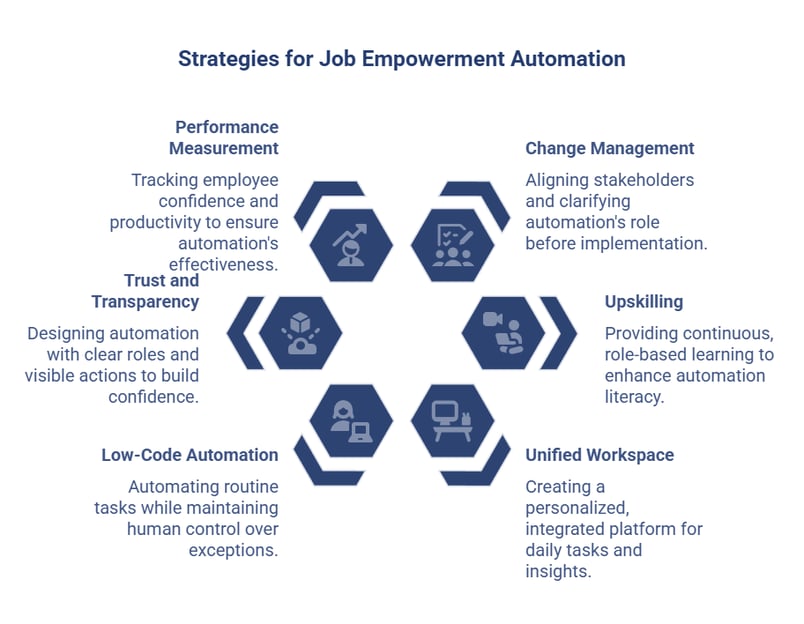
Moving from control-first automation to people-first automation is not a tooling exercise. It’s a total transformation in how you think about work and trust. The shift requires treating automation as an enabler of human capability, not a replacement for it. This is where Salesforce provides a uniquely flexible foundation. When you pair it with the right change strategy and execution mindset, you can achieve this shift. Here are some strategies you can adopt right away:
1. Change Management Before Automation
Your employees resist systems because they don’t understand, don’t trust, or weren’t involved in shaping the automation. You need to align stakeholders before configuring workflows. You need to clarify what automation will and will not replace. This upfront change management ensures automation is positioned as support and not as surveillance. Remember - success is measured not by go-live dates, but by confidence and sustained usage.
2. Trailhead-Based Upskilling
Your employees fear automation that they don’t understand. Salesforce Trailhead addresses this gap by turning learning into a continuous, role-based experience tied directly to real workflows. Instead of generic technical training, your employees can build automation literacy. They understand how flows, rules, and data support their day-to-day work. This shift transforms automation from a black box into a shared capability. It turns your employees into advocates rather than passive users.
3. Experience Cloud Employee Portals as the Front Door
Job-empowerment automation requires meeting employees where work actually happens. Experience Cloud helps with this by offering a unified workspace where tasks, approvals, insights, and learning coexist. Experiences are personalised by role and responsibility. This reduces system-hopping and context switching. Automation becomes embedded in daily work. It’s visible when needed, invisible when not.
4. Low-Code Flow Automation That Augments Roles
With Salesforce Flows, automation focuses on repetition, not judgment. Routine steps are automated. Insights are surfaced at the right moment. Your employees remain firmly in control of exceptions and approvals. Because Flow is low-code, your teams can continuously refine processes as roles evolve. Best part - there are no disruptive re-implementations. Automation stays adaptive, not rigid.
5. Build Trust and Transparency into Automation Design
To make automation empowering, design trust into the system from the start. Use Salesforce’s role-based access and permission models to clearly define where automation acts and where human control remains. Ensure automated actions are visible and explainable. Your employees should understand why something happened, not just that it happened. Keep humans intentionally involved in exceptions and approvals, and communicate openly about what automation tracks and what it does not. Transparency removes fear and prevents automation from feeling imposed or supervisory.
6. Measure Job-Empowerment Beyond Deployment
Deployment alone does not signal success. Confidence does. Measure how willingly employees use automation in their daily Salesforce workflows, not just whether it exists. Track time saved per role, reductions in manual handoffs, and declining reliance on spreadsheets or off-system workarounds. Pair these signals with regular employee feedback to understand whether automation is reducing friction or adding to it. When productivity improves without increasing burnout, automation is truly empowering.
How Brysa Can Help with This Transformation?
Shifting from job-hugging automation to job-empowerment automation requires more than Salesforce expertise. It needs a people-first implementation mindset. Brysa partners with organisations like yours to design Salesforce implementations that are grounded in change management and role clarity. Rather than automating processes in isolation, we align stakeholders, workflows, and governance models to ensure automation augments roles instead of constraining them. By combining thoughtful design and ongoing optimisation, we help you realise the full value of Salesforce, where technology works for people, and not the other way around. Contact us if you are ready for this transformation.