

In the early days of building a business, hustle might feel like a superpower. Rapid experimentation and sheer willpower can generate momentum and create early wins for your business. But what works at “zero to one” rarely works from “one to a hundred.” Over time, working harder begins to produce diminishing returns your effort increases, output plateaus. The uncomfortable truth is: growth rarely fails because of a lack of effort; it fails because of a lack of systems. Sustainable scale demands a shift to System-led growth, where repeatable processes and frameworks carry the weight that raw effort once did. Without the right systems, businesses often face rising Tech debt that slows Business scalability. This is where Salesforce stands out as one of the best investments for automating business processes, enabling Business process automation, Workflow automation, seamless Data integration, and creating a Single Source of Truth (SSOT) through Customer Relationship Management (CRM) solutions—all of which accelerate Digital transformation and help businesses scale sustainably.
A modified version of this article appeared in the European Business Review.

When Hustle Stops Working?
Here’s a simple formula for you. Hustle works only when:
- Your team is small (2-3 members)
- Information lives in people’s heads
- Decisions happen in minutes, not after long meetings
- Goals are short-term and rarely compete.
In such an environment, intensity generates momentum. Everyone has context. Alignment is instinctive. Progress feels fast and fluid. But scale changes the equation. Complexity expands. Stakeholders multiply. Priorities begin to overlap. The very model that once powered growth starts to strain under its own weight. When results depend on individual effort rather than institutional infrastructure, scale becomes fragile by default.
Gradually, you, as the leader, become the system. Every approval routes through you. Every escalation lands on your desk. Every critical decision waits for your input. Firefighting overtakes forward planning, and growth shifts from intentional to reactive.
The Hidden Costs of Hustle-Driven Growth
At first, hustle will feel productive. But over time, its hidden costs begin to surface, and they compound.
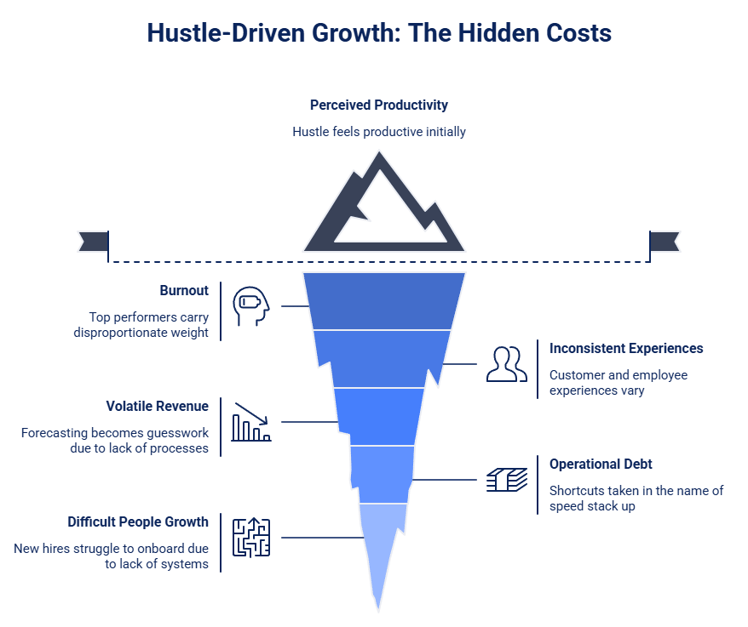
- Burnout becomes normalised: Your top performers will carry disproportionate weight. You, as the leader, will operate in constant response mode. High energy will slowly turn into exhaustion, and resilience will give way to fatigue.
- Customer experiences become inconsistent. When processes live in people (and not in systems), your customer journeys and employee experiences will vary. Outcomes will depend on who handles the task, not on a defined standard.
- Revenue becomes volatile: Without predictable processes, forecasting will turn into guesswork. Growth spikes will be followed by unexpected dips. Pipeline visibility will weaken.
- Operational debt accumulates: Shortcuts taken in the name of speed will stack up. There will be undocumented workflows and duplicated efforts. What once saved time will start creating friction at scale.
- People's growth becomes harder, not easier: New hires will struggle to onboard because knowledge isn’t codified. Performance will depend on shadowing and not on systems. Instead of accelerating growth, adding people will introduce complexity.
Implementing the Shift to a System-Led Framework
Moving to system-led growth requires deliberate design. Here are actionable steps to operationalise the shift:
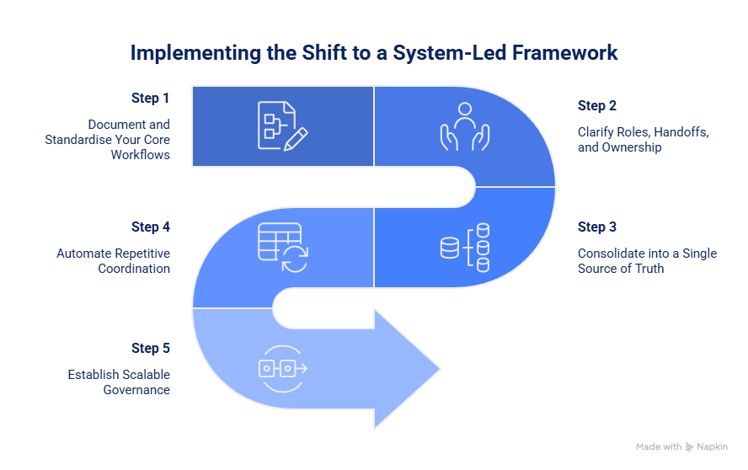
Step 1: Document and Standardise Your Core Workflows
Begin by mapping your most critical revenue and delivery processes end-to-end. Identify the stages, decision points, inputs, outputs, and success metrics for each function. Codify them into clear playbooks so execution becomes consistent regardless of who is involved. The objective is to remove variability and ensure performance is driven by process discipline and not by individual heroics.
Step 2: Clarify Roles, Handoffs, and Ownership
Define explicit ownership for every stage of the workflow and formalise handoffs between teams. Accountability should be structural and not situational. When roles and responsibilities are clear, decisions accelerate. More importantly, work stops falling into invisible gaps between departments.
Step 3: Consolidate into a Single Source of Truth
System-led growth requires unified visibility. Audit your tools and eliminate data silos by centralising operational and revenue information into one reliable system. Leadership decisions should be based on real-time data and not on conflicting spreadsheets. A single source of truth strengthens forecasting and strategic clarity.
Step 4: Automate Repetitive Coordination
Manual coordination does not scale. Identify repetitive tasks such as status updates, reminders, reporting, follow-ups, etc. Automate them through defined triggers and workflows. Automation reduces cognitive load and dependency on memory. It frees you and your teams to focus on higher-value strategic initiatives rather than administrative orchestration.
Step 5: Establish Scalable Governance
Governance should enable speed and not restrict it. Define approval thresholds and risk parameters that provide clear operational guardrails. When teams understand the boundaries within which they can operate autonomously, execution becomes both faster and more controlled. Effective governance ensures scale without introducing bureaucratic drag.
Benefits of System-Led Growth: From Effort to Predictability
The shift to system-led growth transforms how you expand as an organisation. The transition converts your ambition into a scalable operating model. Here are some benefits of system-led growth:
- Infrastructure multiplies results without multiplying exhaustion.
- Success is driven by process discipline, not individual brilliance.
- Teams operate with defined workflows instead of improvisation.
- Forecasts and strategy are grounded in real visibility.
- Roles and performance metrics are clearly defined.
- Outcomes stabilise across quarters.
- Growth becomes engineered rather than accidental.
- You gain clarity on revenue and resources.
- Scale no longer hinges on a few high-capacity contributors.
- Your organisation operates as a controlled growth engine, not a reactive machine.
Put simply; System-led growth does not eliminate ambition. It institutionalises it. It ensures that progress continues even when intensity fluctuates.
Technology as the Backbone of System-Led Growth
System-led growth cannot exist in theory alone. It requires infrastructure. This is where technology enters the picture. As complexity increases across your sales, operations, marketing, and service functions, spreadsheets and disconnected tools will no longer support scale. A unified platform becomes the operating backbone that standardises workflows and embeds accountability into everyday execution.
Platforms like Salesforce enable this transition by turning strategy into structured systems.
- Sales pipelines become measurable and stage-defined.
- Service processes become trackable and SLA-driven.
- You gain real-time visibility into revenue, health and operational capacity.
- Instead of chasing updates across teams, you operate from a single source of truth.
- Approvals, handoffs, reporting, and customer journeys are system-triggered rather than memory-dependent.
- Governance is embedded into workflows, allowing your teams to move fast within defined guardrails.
How Brysa Enables the Shift from Hustle to System-Led Growth?
Brysa partners with growth-stage and scaling organisations to diagnose where performance depends on individual effort instead of institutional infrastructure. By combining strategic process design with structured implementation on Salesforce, we help businesses replace fragility with repeatability and convert operational chaos into measurable systems.
Through our consulting services and implementation services, we enable this shift by:
- Identifying people-dependent growth risks: We pinpoint where/when your revenue or decision-making relies on specific individuals rather than structured systems.
- Designing scalable operating models: We build aligned frameworks across different functions that support coordinated scale.
- Standardising workflows and handoffs within Salesforce: We embed clarity and accountability directly into the system.
- Replacing manual effort with automation: We implement structured processes that reduce coordination overhead and execution variability.
- Building Salesforce as a true operating system: We transform it into the backbone for revenue and performance management.
- Reducing founder and hero dependency: We ensure growth no longer hinges on constant executive intervention.
- Enabling leadership visibility and governance: We provide real-time insights and predictable forecasting to support confident scaling.
Ready for this shift? Contact us to kickstart the process.