

For decades, enterprise systems carried an invisible label: “not for small businesses.” They were built for global corporations with deep pockets, relying heavily on legacy systems and complex setups. Everyone else simply worked around them with spreadsheets and manual processes. But that rule has been shattered. With the rise of cloud computing and Software as a Service (SaaS) platforms like Salesforce, along with rapid adoption of Artificial Intelligence (AI)—now used by over 1 million businesses—these capabilities are becoming accessible to fast-growing teams, enabling data integration, Customer Relationship Management (CRM), and true business scalability as part of ongoing digital transformation.
So what changed? If enterprise systems were once built only for the biggest companies, what pushed the industry to rethink that model? To find the answer, we need to first understand the growing disconnect between traditional enterprise software and the needs of modern businesses.
A modified version of this article appeared in Corporate Vision.

|
Key Takeaways
|
How Traditional Enterprise Systems Failed Modern Businesses?
Traditional enterprise systems were built for a different era. It was better suited when businesses moved slowly. It was okay when IT teams controlled every change. It was fine when long implementation cycles were acceptable.
But modern companies operate differently. They value agility over anything else. Most legacy enterprise platforms struggled to keep up with this basic expectation. Several structural limitations of these platforms also led to this situation :
- Monolithic architectures slowed innovation. It made updates and feature releases complex and time-consuming.
- Heavy customisation created technical debt. It forced companies to maintain fragile and hard-to-scale systems.
- Vendor lock-in reduced flexibility. It made it difficult for businesses to adapt or integrate new technologies.
- Poor user experience limited adoption. Employees had to rely on workarounds like spreadsheets.
- Systems were designed for large IT teams. It made them impractical for lean and fast-moving organisations.
Together, these limitations showed a clear reality: traditional enterprise systems were unsuitable for both kinds of modern businesses: the Davids and the Goliaths.
The Turning Point: The Rise of Modular and Cloud-Based Enterprise Platforms
Once the limitations of traditional enterprise systems became apparent, a new generation of platforms emerged. It was tailored for those who no longer wanted systems that took years to deploy or required heavy customisation. These platforms supported growth without slowing innovation. It was a shift that led to the actual democratisation of enterprise systems.
Modern enterprise systems are largely cloud-based and modular in nature. Rather than forcing growing businesses to stick to a rigid system, these platforms allowed them to build their stack in a more adaptable way.
- Cloud infrastructure: It played a major role in accelerating this transformation. By eliminating the need for on-premise servers and complex installations, cloud platforms made enterprise systems easier to deploy and scale. Growing businesses could now access powerful enterprise tools through a browser while benefiting from automatic updates and reduced infrastructure costs.
- Modular architectures: It introduced a more composable approach to enterprise technology. Instead of relying on one large monolithic system, businesses could combine different modules that work together seamlessly. This approach allowed them to experiment with new tools and adapt their systems without disrupting existing workflows.
How Modern Enterprise Systems Have Become Accessible to Businesses of All Sizes?
This shift is largely driven by cloud infrastructure and the modular architecture of modern platforms. Let us take a closer look at the key reasons behind this change.
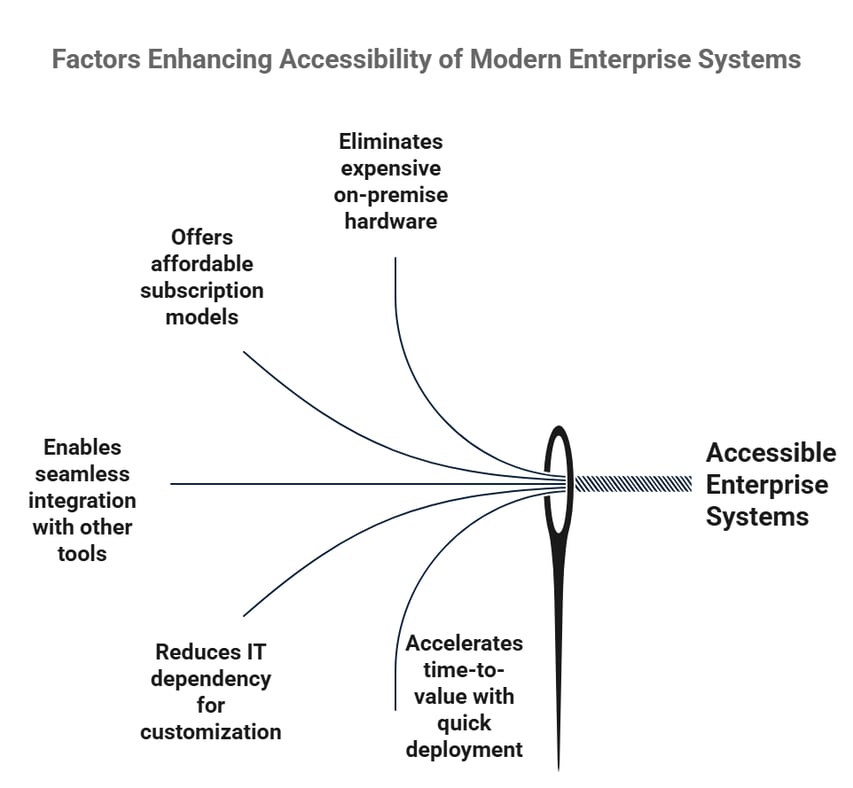
1. Cloud-Based Infrastructure Removes Cost Barriers
Cloud technology has eliminated the need for expensive on-premise infrastructure. Instead of investing in maintenance and upgrades, you could access enterprise systems through the cloud. This significantly reduces upfront costs and allows you to start using advanced systems without heavy IT investments.
2. SaaS Pricing Makes Enterprise Tools Affordable
Subscription-based SaaS pricing models have made enterprise platforms far more accessible. You now pay monthly or annually based on usage rather than committing to large upfront licensing fees. This allows you to adopt enterprise systems gradually as your needs grow.
3. API-First Platforms Support Seamless Integrations
API-driven architectures allow enterprise systems to integrate easily with your other software tools. This means you can connect your CRM, marketing platforms, analytics tools, and customer support systems into a unified ecosystem without disrupting existing workflows.
4. Low-Code and No-Code Tools Reduce IT Dependency
Many modern enterprise platforms include low-code or no-code capabilities that allow your teams to build workflows and customise dashboards without extensive programming knowledge. This allows you to manage systems without relying heavily on large IT teams.
5. Faster Implementation Accelerates Time-to-Value
Traditional enterprise implementations could take years to complete. Today’s platforms are designed for faster deployment, allowing you to go live within weeks or months and start seeing operational improvements much sooner.
Six Telltale Signs It’s Time to Switch to Enterprise Systems
If you are still unsure whether enterprise systems are the right fit for your business, there are several clear indicators that it may be time to make the shift. The following signs often suggest that your organisation has outgrown its current tools and would benefit from a modern enterprise system:
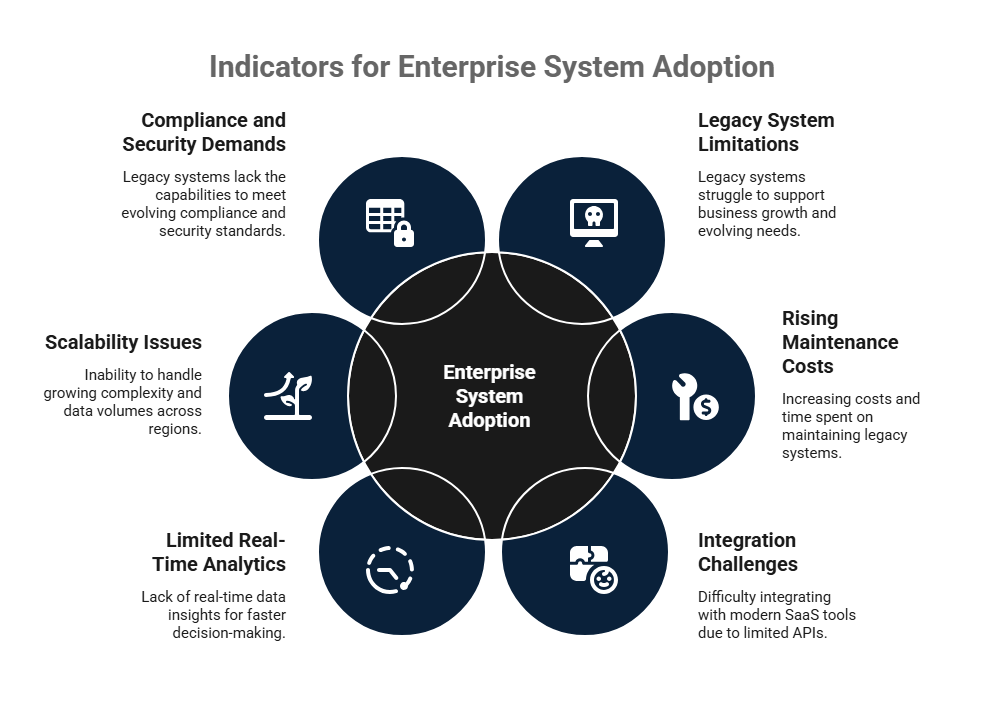
- Legacy Systems No Longer Support Growth: Your business is expanding into new markets or customer segments. Your legacy systems are struggling to support evolving operational needs.
- Rising Maintenance and Infrastructure Costs: Your organisation is spending increasing time and resources maintaining legacy on-premise systems. It is getting expensive to manage infrastructure and handle frequent upgrades.
- Integration Challenges with Modern SaaS Tools: Your teams are using multiple SaaS tools for CRM, marketing, analytics, and collaboration. But your existing systems struggle to integrate with them due to limited APIs or outdated connectors.
- Limited Access to Real-Time Analytics: Your leadership team often has to rely on delayed reports or manually compiled data. It is making it difficult to access real-time insights needed for data-driven decisions.
- Scalability Issues Across Regions or Business Units: Your business is expanding into new regions or adding business units. But your current systems are struggling to handle the growing complexity and operational workflows.
- Increasing Compliance and Security Demands: Your organisation is facing stricter compliance requirements and higher security expectations. But your legacy systems lack the built-in capabilities needed to keep up with evolving standards.
How Brysa Helps Growing Businesses Adopt Modern Enterprise Systems?
Adopting a modern enterprise system is not just about selecting a new platform. It requires aligning technology with the way your business operates today. Brysa works closely with you to:
- Map business requirements
- Evaluate the right enterprise platforms
- Design modular system architectures that support long-term scalability
Instead of forcing you into rigid solutions, our focus is on configuring systems that fit your existing workflows. At the same time, our approach remains flexible enough to evolve as your business expands.
Our implementation services combine industry-specific expertise with agile implementation methods that prioritise faster time-to-value. By avoiding unnecessary customisation and overengineering, we help you implement enterprise systems that are powerful and easier to manage. Even after deployment, we will continue to support you with optimisation and governance to ensure that your enterprise investment keeps delivering value as your organisation grows.
Modernising your enterprise systems starts with the right guidance. Our consulting services help you select the right platform and build a practical implementation strategy for your business.